

The internet is full of ALL OF THE THINGS YOU MUST BE DOING NOW to improve your language skills. This can be somewhat panic-inducing, especially if you just don’t get on with some of the “MUST-DO” tasks, some of which – like apps claiming to be able to teach you a language in your sleep – are simply tips worth ditching.
As someone who has successfully learnt 4 languages well enough to…
- study at a university abroad (Italian)
- get a job working in the language (Spanish)
- have a relationship in a foreign language (Portuguese)
- pass a C1 exam (French)
…I can tell you that some of the most “recommended” language tips are simply not followed by most polyglots. So I thought I’d share a list of methods that simply don’t work for me, to show that it’s not about doing all of the things all of the time, it’s about finding 1) what has been proven to work 2) what works for you.
1) Memory-based vocabulary apps
Whilst it’s important to continue to build upon your vocabulary in your target language, I personally find memorisation games incredibly boring and pretty ineffective.
Yes, they might teach you to list off a group of words on a particular topic if asked, but that doesn’t automatically translate into using them in sentences in a conversation.

Instead, I prefer to learn vocabulary in context. If you can learn to deduce meaning from a wider text (as part of a book or blog), from pictures or tone of voice in conversation, you will equip yourself with more tools than simply the ability to recall random words out of context. You can learn to do this by reading (with the right techniques!) in your foreign language, or learning active listening skills as starting points.
The only time I would subject myself to the drudge of memorisation is upon starting to learn a new language; in this case, I would put in the time to learn the 1000 most common words in the language on Quizlet (Spanish, French, Italian, Portuguese). Beyond that, however, I’d sack off memorisation apps altogether.
2) Hypnopaedic learning (sleep learning)
Just, no. This is so dumb. If this were possible, then everyone would be doing it. This method fails to distinguish between hearing and listening, which are two very different things.
To acquire a language, you need to engage actively in the language; learn 5 free ways to become the ultimate active listener in any language.

3) “You won’t learn anything stuck in a classroom”
This is hokum. Lots of learners talk about how “your class only goes as fast as the slowest/weakest learner.” This simply isn’t true. Good teachers are masters at “differentiation”, which is the practice of tailoring everything from instructions, information presentation, activities and assessment to the nuances of each learner’s profile. If you feel that your class is moving too slowly, you have a right to request differentiated work, and the same applies if you feel left behind.
Remember also that it’s unlikely that you will become fluent if you never step out of a classroom, so make sure not to frame your classes as the only source of your progress.
It still stands that with the right teacher and classmates, you can really accelerate your learning. This is especially effective if you do this in-country. Check out my post on booking a language immersion course abroad for more on this.
4) Comic books
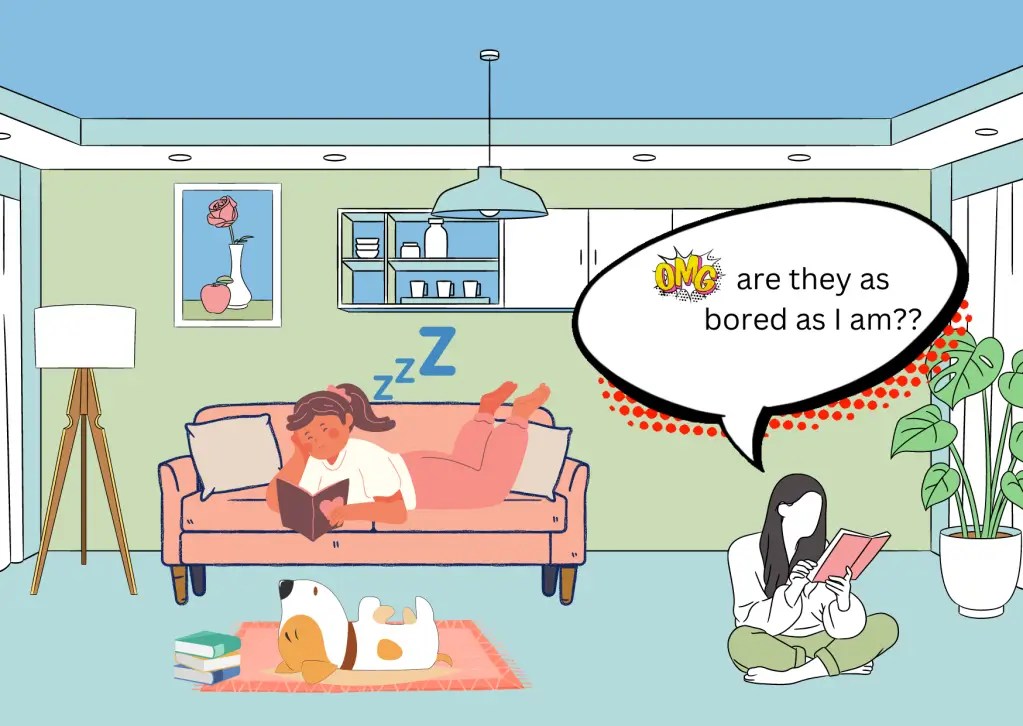
Erghhhhhh. I’m not a fan of comic books in English anyway, and have to really strain to appreciate satirical comic sketches in newspapers, so it’s not going to work for me.
The hardest thing I find is to work out which speech bubble to read in what order.
I appreciate that this is very much a personal preference; if you enjoy comics in your native language, then you may enjoy them in your target language, but remember that there may be text language, slang or cultural references that might currently be beyond your remit if they’re comics for native speakers, which can deter learners from the language altogether due to the difficulty in deciphering them.
5) Any podcast where you listen to other people learn
Snore! I have many childhood memories of my mum listening to jittery old Michel Thomas tapes in the car – very quick way to send me to sleep.
Check out my posts on podcasts I do recommend in French, Spanish, Italian and Portuguese.
6) Changing the language on my phone
Spare me. I’m not great with technology at the best of times, let alone when my phone’s projecting a load of words that wouldn’t even make it into day-to-day conversations in my desired target language.
Words like “screen time”, “voice memos” and “icon” are not high-frequency words in any language. The steroids version of this is to change Alexa or Siri’s language. Destination rage.

7) 1-2-1 classes

This is very much a personal preference, as I prefer to have other students to bounce ideas off, pick up vocabulary from, and correct (in my head!), all as learning techniques.
I find 1-2-1 a bit intense for general lessons, but I’d maintain that they’re really useful for conversation if you need to build your confidence.
8) Remote classes
I borrow from artist David Hockney for this one, who rightly said that “The thing with high-tech is that you always end up using scissors.” I am a pen and paper fan (and scissors for a bit of crafting!) and I bounce off other people’s energy, which is hard to do through a screen. I’m less likely to bunk off a remote class, admittedly (especially on a rainy English day), but when I calculate results for time spent, I’d choose in-person lessons every time.
My exception for this is if classes are for a limited duration. For example, I highly recommend the Lingoda language sprint, which you can read about in my Should you try the Lingoda language sprint? Here’s my experience and advice post. The method works really well, but by 6 weeks I was very much ready to finish.
9) Dual language books
In my view, these are only useful for translators. For the rest of us, those not particularly advanced in the target language risk relying too heavily on the native side of the book, whereas those further along simply do not need that native crutch. Pointless.

Instead, try a graded reader pitched at your level for effective reading.
10) Basic phrase books
These are useful for a weekend trip away to a place where you have no concept of a language, but when you have no idea about the construction of the sentences you’re saying, you’ll quickly hit a wall.
I am a big fan of physical books and textbooks though, something you can touch to refer back to when you need a top up. I find working electronically doesn’t feel like I’ve actually done any work once I shut my laptop… It’s really satisfying being able to flick back through a workbook or story to see your answers or annotations, as proof of all the work you’ve put in.
Final thoughts
Ultimately, everyone learns differently so there may be some language tips I’ve ditched that you swear by – and that’s ok. If it’s genuinely working for you, then carry on. Just don’t pay a load of money for sleep learning – that one really is a scam!
Are there any tips that others swear by that just don’t work for you? Comment below!


Leave a comment