

We’ve all been there, having greeted restaurant staff in French, only to have them reply to us in English. Frustrating, I know!
If you persist, they will eventually humour you, unless you’re in a particularly nasty Parisian tourist trap.

Find below a list of the most useful phrases to use when dining out, and also, what you may be asked, and how to respond.
What to say
Je prends…
This can bring British people in particular out in a rash… What? Demand that I’ll have something, rather than asking politely if I could “possibly have the steak, please?”.
But it’s just what they say, so use it.

De l’eau, s’il vous plaît
You’ve got three options here, but they’ll offer you two when you ask for this: “gazeuse ou plate?” (sparkling or still?). Do not feel embarrassed to ask for “de l’eau du robinet” (tap water).
As for the confusion as to when to use a definite article, just memorise the following:
Une bouteille d’eau = a bottle of water
De l’eau = some water
Monsieur/madame…?
This is generally preferable to the classic and quite anglo “excusez-moi”, which the French don’t use as much to grab someone’s attention. Remember that you should only use this once you’ve done the formalities (i.e. the classic “Bonjour”), so is useful once you’re seated at a table and have already spoken to the server.
If you’re waiting to be seated at a restaurant, ALWAYS say “Bonjour” or “Bonsoir” as you start to address the staff.
A quick note on pronunciation: it can be very tempting to pronounce the “n” in “Monsieur”, but don’t!
And the “o” is not an English “o”. Hear it on forvo.com. Say it over and over again whilst listening to the recording to avoid becoming Madeline Wheeler from Emily in Paris:

Est-ce que je peux régler? / L’addition, s’il vous plaît
Whilst “L’addition, s’il vous plaît”, is a common way to ask for the bill, you can also ask to “settle up” by saying “Est-ce que je peux régler?”. This works in a restaurant and is what you should definitely say in a bar.
What you might be asked
Vous allez prendre un apéritif pour commencer?
You’ll have guessed that this means “would you like a pre-lunch/supper drink?”. This is always a good opportunity to ask “qu’est-ce que vous recommendez?” (what do you recommend?) as different regions have different specialties.
For example, in Perigord, “vin de noix” (nut wine) is hugely popular and is delicious.

Et la cuisson?
You’ll be asked this if you order a steak. Generally speaking this only applies to beef; for other dark meats like duck, lamb and venison, you will get it as the French think you need it, to which you can respond:
Bleu (very rare)
Saignant (rare)
À point (medium rare)
Cuit (medium)
Bien cuit (well-done)

Order either of the latter two at your peril in France; as author of the book-turned-film A Good Year, Peter Mayle once wrote: “The English murder their meat twice: once when they shoot it, again when they cook it. ‘Drôle, n’est-ce pas’?”
Qui goûte le vin?
When you order wine, they’ll bring it to your table and will invite someone to taste it to check it’s not corked. You can simply respond “moi” or “je le goûterai” (I will taste it).

Ça a été?
They may ask you this question or “ça s’est bien passé?”, which both mean “was everything ok?”. When you answer this, a “très bon” is appropriate if it was delicious. If it wasn’t, you can simply say “oui”, or “ça a été”, if you’re not looking to get into a ruckus. None of this “magnifique” or “incroyable” stuff which will make you stick out as a foreigner in an instant. Effusiveness is just not the done thing in France.
Voulez-vous d’autre chose?
This means “would you like anything else?” and will usually be asked once you’ve had all the standard stuff, i.e. they’ll likely specifically ask you “voulez-vous un café ou un thé?”.
Vous payez comment?
You’ve guessed it – this means “how will you pay?” and your answers can be “par carte”, “en espèces” (in cash) and you wouldn’t believe it but in some places, they’ll still take “un chèque”.
Things worth knowing
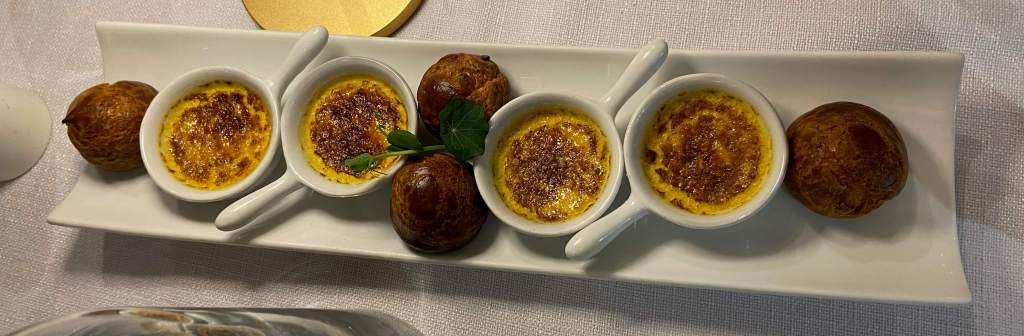
You’ll quite often get an amuse-bouche
Getting a light dish to “warm up” your stomach is common in French restaurants, especially when you’ve ordered a set menu. Don’t worry, these are always on the house, and they’ll normally be a nod to the local specialty.
Keep your cutlery
A lot of places will ask you to keep your cutlery from your starter for your main course. If you’re unsure, you can ask, with the question “on garde les couverts?”.
Tipping isn’t really a thing in France
There’s normally a service charge already stated on your bill so there’s no need to leave a tip (un pourboire).
You’re probably pronouncing the word “dessert” wrong
The English stole the word “dessert” from the French, and changed the pronunciation, so that it sounds a lot closer to the French word for “desert” (désert). “Désert” is pronounced with a [z] sound, whereas “dessert” in French has a hard [s] sound. You don’t pronounce the “t” in either word. Hear the difference between “désert” and “dessert” on forvo.com.

Provenance is very important
If you ask your server about the products you’re eating, you’ll generally find that everything has been locally sourced and very carefully selected to ensure the best quality.
This is such a phenomenon on France, that it’s common to find foie gras farms that offer visits all over the country, where you can see how it’s produced (which leaves me feeling a bit funny…). Here’s an example of a farm in Perigord Noir that produces foie gras made from geese (as opposed to the more common type of foie gras made from duck):
Veganism and vegetarianism are only really catered for in big cities
Most standard menus in French towns will be require you to be able to eat pretty much anything. If you are vegan or vegetarian, I’d recommend sticking to cities when you want to eat out, and cooking at home when you visit more provincial areas, or simply getting used to salad and chips.
Let the wait staff do their thing
You might think you’re being helpful by passing your finished plate to the server but don’t! It ruins the performance of the whole thing in most places, so just sit back and allow them to cater to you.
Final thoughts
When it comes to dining out in France, you have to realise that you are in an involuntary game with the French, charged with proving to them that you are not just another British tourist, something that you will fail at again and again until, one day, a French waiter may entertain the idea that you’re not all terrible. Don’t be offended by this; it’s all part of the fun!
Is there anything else you’ve heard whilst dining out that has completely boggled your mind? Or are there any phrases you’d recommend as staples that I haven’t included? Comment below!


Leave a comment