

I studied Italian at university as part of my joint honours degree, which was a BA in English Literature and Italian.
This meant that I got to spend one academic year in Verona, Italy, under the ERASMUS+ scheme (which was simply ERASMUS, back then).

The ERASMUS+ programme provides opportunities and funding for young people from EU nations to go abroad for a semester or full academic year, either to study at a university or to do a work placement.
Brexit has changed the game considerably for foreign language students in the UK, as well as affecting the prospects for the UK’s place in our global economy, which requires language skills, cultural agility and an environment that welcomes foreigners and fosters intercultural exchange.
Let’s dive in and see what we’re actually dealing with here:
- The stats on studying abroad
- The ERASMUS+ replacement: the Turing scheme
- ERASMUS+ and the Turing scheme: a comparison
- What are the consequences of these differences?
- Final thoughts
The stats on studying abroad
UK Universities International identified that in 2020, only 7.4% of British students studied, worked or volunteered abroad during their degree. Meanwhile, international students made up 20.7% of the total UK student population, and international staff made up 20.9% of all staff at UK universities.
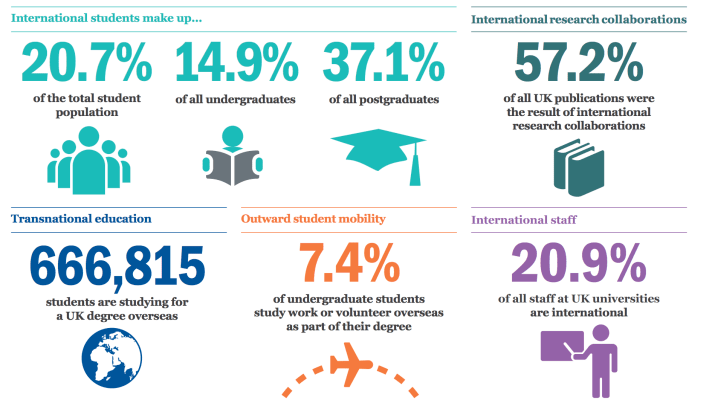
This means that UK institutions have benefitted from a diverse pool of students and staff thanks to a number of factors, including the ERASMUS and other exchange programmes, and the absence of the requirement of work or study visas for citizens of EU members states. The UK has also been a popular destination for non-EU students looking to enter an innovative workforce in a strong economy. The UK economy has equally benefitted from these exchanges hugely, since diversity can drive innovation, and language skills open up access to foreign markets.
Students who spend time abroad during their studies enjoy personal development, enhanced career prospects and improved language skills.
The ERASMUS+ replacement: the Turing scheme
The EU-funded ERASMUS+ programme is named so after after Dutch philosopher and Catholic theologian Desiderius Erasmus Roterodamus, whose name inspired the acronym EuRopean Action Scheme for the Mobility of University Students. It is a student and teacher exchange programme between universities, major European schools and educational establishments around the world.
Post-Brexit, naturally, British people lost the right to participate in the ERASMUS+ programme. The British government has since created the Turing Scheme – named after WWII codebreaker Alan Turing – as a replacement.
ERASMUS+ and the Turing scheme: a comparison
A report co-funded by the Erasmus+ programme called “Bologna with New Eyes 2020” states that national unions of students see financial burden to be the most significant barrier to enrolling in international student mobility programmes.
Despite our government’s insistence that the Turing scheme is the same as, or “better” than the ERASMUS+ programme, this remains to be seen, for a number of reasons. Let’s first look at the fundamental differences between the two programmes. Use that zoom to see the infographic:
What are the consequences of these differences?
The UK becomes a less viable destination for international students and workers
The Turing scheme, unlike the ERASMUS+ programme, is a one-way street, in that whilst it matches ERASMUS’ sending of home students abroad, it doesn’t facilitate foreign students coming to the UK.
British students are also now subject to non-EU fees if they’d like to complete their whole degree at a university in an EU nation, which became the preferred choice of some students after the British coalition government raised tuition fees in 2010.
Non-EU fees at universities in EU country vary significantly by country and whether the university is public or private, meaning that some degrees abroad will still be cheaper than degrees at home for British students. For example in Italy, some public universities only charge registrations fees, which can vary from 0-5,000€ per academic year. In Sweden, non-EU students can expect to pay between 7,500 – 25,500€ per academic year. Since British students are only entitled to a maintenance loan if they study at university within the UK, studying abroad to avoid paying extortionate university fees will require cash in the bank from the offset.
The results of this are that only students from wealthier backgrounds can essentially buy their way into the EU work market, since student visas provide a window of opportunity for job seeking post-graduation.
The product of these changes is that the UK will become less diverse over time, as with fewer international students in the student body, fewer foreigners will enter the workforce. Whilst it’s true that Brexit has not changed the conditions of non-EU students coming to the UK to study, we have lost a huge intake from our continental neighbours.
This does not just affect industries’ ability to recruit high-skilled workers from diverse backgrounds, but the acute labour shortages that have resulted from the need for work visas post-Brexit have contributed to the UK’S growth prospects becoming the worst among top economies.
Languages becomes a subject of the privileged
As for the impact of the change to the Turing scheme for British students, the funding limitations are significant. Since only students from households with an income below £62,311 are entitled to Turing funding, many students will be expected to pay for their year abroad out of their maintenance loan and own pocket. On top of this, unlike under the ERASMUS+ programme, British students will still be expected to pay some fees to their home university, despite not stepping on their home campus once.
To add insult to injury, students on a work placement who are not in receipt of Turing funding will receive only 1/3 of their maintenance loan, presumably because they will be earning a stipend on placement. Take into account “internship” wages and currency conversions, this can leave students at even more of a financial disadvantage.
Of the students who are entitled to the funding, since higher education institutions must apply on an annual basis, those entitled students are left hanging til late in the year, before finding out if they will in fact get funding.
Over the long term, this may well discourage students from disadvantaged backgrounds – who the scheme supposedly aims to help – from even applying to study languages at university in the first place.
British citizens now require a visa to stay in the EU for long than 90 days.

This means that students must pay visa fees and face further financial difficulties like providing proof that they can support themselves throughout the year as part of the visa application. This can amount to thousands of pounds being needed in their bank accounts.
The potential result of this is that languages will become a subject for students from more privileged backgrounds, whose parents can support them financially.
Language learning changes direction
A lot of Brexit’s advocates have put considerable emphasis on other study destinations, which are still on the table, as David Frost (member of the House of Lords) told Emily Maitlis on The News Agents:
Exchanges between anglophone countries are of course culturally enriching, but the shared history and heritage of these countries makes such exchanges potentially less novel for students, which reduces the possibility of growth, and naturally eliminates the need for language learning.
With fewer opportunities to use European languages post-graduation, students may not bother to learn any languages at all, or might be swayed by government incentives to learn Arabic, Mandarin or Russian, which are amongst the small group of languages highly sought after by GCHQ, MI5 and MI6. The Civil Service Fast Stream includes a scheme that offers language courses in Arabic and Mandarin.
This may impact educational policy long-term, knocking French, German and/or Spanish off the state school curriculum, leading British people to be even less able to communicate with our neighbours in their native languages.
British people will be undesirable candidates for many UK jobs
The focus on Commonwealth and other anglophone countries plays into the narrative that “everyone speaks English”, which may result in fewer students choosing to study languages at university because “you don’t need to”. This does not reflect our globalised world, which increasingly sees non-native English speakers able to offer fluent English as well as their native language (and potentially other foreign languages) to employers working in international markets, something British people won’t be able to compete with if we continue down this trajectory.
Young people will struggle to emigrate to the EU without experience
Aside from studying abroad, the European Solidarity Corps (another feature of ERASMUS+) is a great way to gain experience overseas, even if you don’t have a degree. Read my Work abroad with no experience: 7 reasons to participate in the European Solidarity Corps post to learn about my experience of participating in the prior pre-Brexit.

Following such placements, it’s much easier to secure a job in a different country when you’re already in situ abroad, showing potential employers that you’re committed to a particular city, country or language.
The Turing programme has an internship scheme in the fields of TEFL and Digital Marketing, which is far more limited than the array of fields available under ESC. The maximum internship period is 13 weeks, compared to 1 year for ESC.
A lot of countries’ work policies require that companies advertise a job advert for a certain amount of time (in France, it’s 3 months) before choosing to employ a non-EU citizen, at which point, they have to prove that no national has the same level of experience and/or skills for the role. Then they’ll need to pay a hefty sum for the visa process (in France it’s currently around 3,000€). This means that only mid-career professionals in high-skilled professions will stand a chance with this, if a company is willing to wait on the paperwork.
Final thoughts
I always like to leave my blog posts on a light-hearted or positive note at the very least, and provide solutions to problems where I can. Unfortunately, I don’t feel in a position to do this with this topic.
We need serious political reform for the prospects of language students and for the future of language learning in the UK to improve, to ensure that young people are not left behind in terms of the acquisition of language skills, and to enable all British citizens to work abroad with ease, as we could do in the past.
Sources:
http://www.goabroad.manchester.ac.uk/finance-and-funding/turingscheme/
https://www.youngcapital.nl/immigration-netherlands/residency/turing-erasmus
Have you been on your year abroad since this change of scheme? Please comment below and share your experience; I’d love to hear from you!
Psst! If you liked this post, please give it a like below 😊👇!


Leave a comment