

I attended the 2023 Polyglot Gathering for the first time this year, where, on a whim, I decided to apply to speak at the event.
In hindsight, if I’d attended purely as a participant prior to this, I don’t think that I would have ever applied to speak.
I was amazed at how many content creators I met at the Gathering, some of whom had huge followings, had given Ted Talks and more.
As someone with next-to-no digital footprint, I really didn’t fit this profile.

My ignorance was bliss, it seems. I’ve never subscribed to the saying that tells us that “in order to break the rules, first we must master them.” Instead, sometimes when we don’t know how the land lies, we think beyond it.
At this point you’re probably thinking that I’m talking about public speaking like it’s missionary work. Some women speak in public regularly and there was a handful at this year’s Polyglot Gathering. Some women won’t identify with my hesitation at putting myself forward at all.

Yet, we can’t ignore the fact that globally, almost 70% of all event speakers are male.
This lack of representation of women feeds a narrative that experts look a certain way, something that is both a product of and a cause of the fact that women are significantly underrepresented in the media. Men remain the majority of quoted experts and sources globally.
In an attempt to motivate others to speak at events in future, I thought I’d share the process I went through to prepare for my talk. Do other people prepare this much? I’ve no idea. I can only tell you what I did.
Pre-event
1) I applied as a participant and only later applied to speak
I actually applied to speak twice, first accidentally filling in the form for the 2023 online event (duh!), which, since it had already passed, was not monitored. This gave me an out to my spur-of-the-moment confidence; as Kerstin Cable – one of the founders of Women in Language – has said, “women can talk themselves out of stuff a lot.” And I was one of them!
It was only a couple of weeks later that I happened upon a Youtube Live by Richard Simcott, in which he discussed the juxtaposition present in the languages industry, where women dominate the field, but men front it at events.
I considered Richard’s live a sign from the universe that I needed to talk myself back into speaking, not just because I AM WOMAN, but also because I had wanted to talk about this exact topic.
My carpe diem energy was back and I managed to find the right form on the website, to re-apply and have my talk entitled “Why the majority of well-known polyglots online are men and what we can do about it” accepted.
“Yay and oh no!”, I thought. Now I have to do it 🫤

This mixed feeling isn’t a uniquely female problem; I remember chatting to a male speaker over the bar prior to my talk, where he similarly expressed that he’d secretly hoped that his talk would be rejected, due to nerves!
2) I did a load of research and made lots of notes
I received news of my talk being accepted a month prior to the Gathering. Research was to be my best friend. I was most of my way through Mary Ann Sieghart’s The Authority Gap: Why women are still taken less seriously than men, and what we can do about it by the time I’d applied to speak, which, it won’t surprise you, was the inspiration for my talk.
I love Sieghart’s approach, which presents such an overwhelming amount of undeniable data and personal stories from women all over the world, with plenty of solutions in tow.


3) I reached out to others for advice and feedback
The next thing that occurred to me was the need for testimony from people who had lived through the development of the polyglot world, from the early days of Reddit, up to the first Polyglot Conferences, Gatherings and other events. I contacted Richard Simcott, who kindly agreed to speak to me about his experiences as an event organiser.

I also reached out to the Women in Language founding team; Lindsay Williams was kind enough to send me reams of her and others’ accounts, relevant studies and her opinion on a series of questions I’d sent to her.
She even agreed to read and give me feedback on my first draft, which I booked in with her for a week later, giving me a hard deadline to get something on paper.
Kerstin Cable also sent me a load of really helpful links, and directed me to the Facebook group Polyglotessa (a support group for female polyglots), recommending I reach out for stories, which I did.
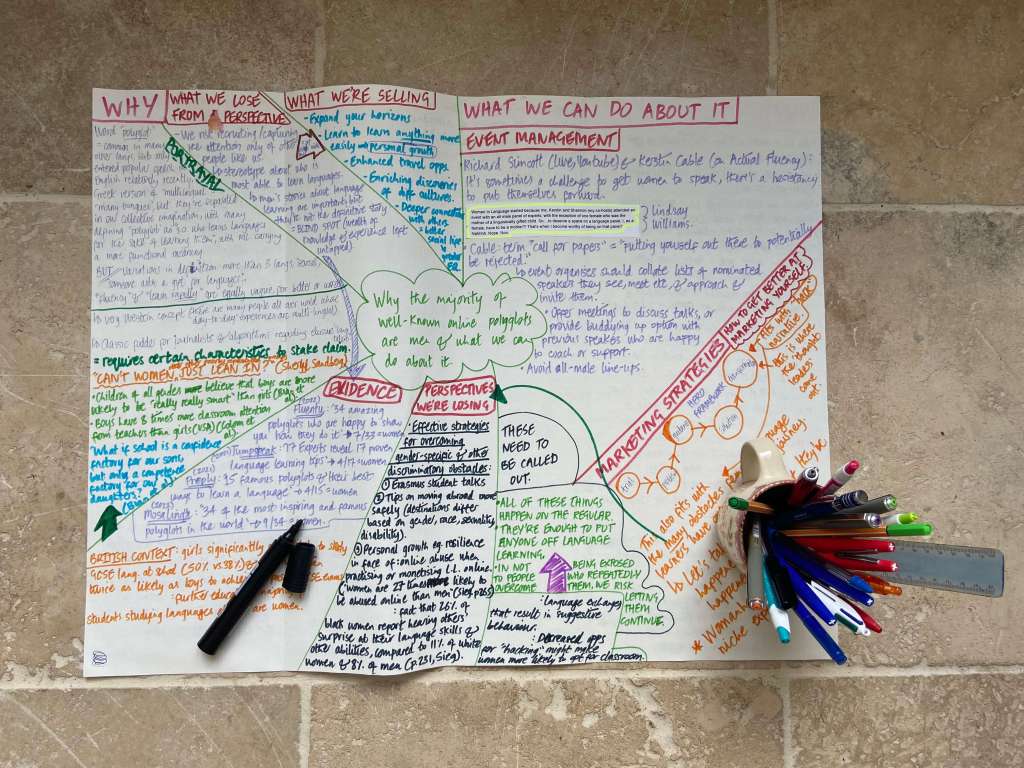
4) I reorganised my notes into something that worked for my brain
With plenty of material from Richard, Lindsay and Kerstin, as well as my own notes on Sieghart’s book, multiple studies and every other mad idea that had flown into my head, I wasn’t ready to type anything official-looking yet.
Instead I bought a piece of A1 paper and got scribbling.
5) I used the Storyteller Tactics cards to structure my talk
Doom-scrolling on Instagram one day, the Storyteller Tactics guys got me! I was sold on wanting to give a talk that was neither so data heavy and monotonous that your audience ends up half listening whilst checking Twitter, nor caked in cultish rhetoric that simply does not hold up to scrutiny.
Rather than hand over an eye-watering 99.99€ for the digital cards alone, I took advantage of the free content on the Pip Decks website. There, you can choose whether you want to sell, motivate, convince, connect, explain, lead or impress. I went with “motivate“, which provided me with the structure for my talk.

I made sure to answer:
What are you trying to achieve? Big picture stuff.
What’s motivating you? What might motivate us too?
What’s stopping you? What barriers must you overcome?
Reassure us about the risks you’re asking us to take.
Give us a realistic idea of the journey ahead.
6) I wrote and got feedback on my first draft
The next thing I did at this stage was to put some slides together and write my first draft.
I sent the draft to Lindsay prior to our meeting; during our meeting, she gave me a huge amount of really helpful feedback, which informed my final content-level edits.

7) I rehearsed, recorded, filmed, watched and listened back

Rehearsing was a really important part of the process, because it allowed me to cut out a lot of fluff. I read out and recorded my talk multiple times, where repeatedly tripping over my words informed my editing, leading me to shake off a lot of wordiness and so on.
Once I’d worked out the exact words I wanted to say, I recorded the whole text, bit by bit, leaving me with a faultless audio file that I could listen to. This also allowed me to predict how long the talk would take (longer live, of course, to allow for dramatic pauses and such!), and how long would be left for the all important Q&A.
I also filmed myself giving the talk a couple of times, to make sure I was engaging my imaginary audience enough.
From this point onwards, I regularly listened to my recorded talk (at a faster speed to make it more bearable). As a result, I started to memorise parts of it, which in turn gave me room to play around, improve my annunciation and such for maximum effect.
At the event
8) I told people about my talk and invited them to attend, asking specifically for support
I held no preconceived ideas about the Gathering before attending, but by the end of day one, I had the feeling that the event had a significant male majority. This gave me comfort in the validity of my message (where are the women?), but also made me concerned that I had perhaps entered the “Lion’s Den”.
I was mid-way through Sam Conniff Allende’s Be More Pirate at the time, which serendipitously reminded me that the Lion’s Den is in fact the best place to communicate your message.
He explains that it may be tempting to test your idea or message by delivering it somewhere comfortable, but in reality, you should go “somewhere that scares you, where you might be likely to offend, where you risk being rejected but where you will inadvertently strengthen your story because the reaction of others will amplify it or their very criticisms will force you to tell it better next time.”

I sought out allies early, – genuinely and not strategically – personally inviting them to my talk, and being explicit about my need for friendly faces.
9) I gave the talk and created connections afterwards
Luckily, a lion’s den, the Polyglot Gathering is not. I heard lots of healthy debate about “why is this event so guy-heavy?” both prior to and after my talk, from attendees and non-attendees alike, which is a result in itself.

And my favourite part of this process was that a number of women came to speak to me at the end of the talk, to share their stories and experiences of being a woman in the languages industry, online and abroad.
Men also approached me to continue the conversation and expressed their allyship and interest in the subject.
What I learnt
Commit first, and work it out later
My talk started as a 5-line description in a Google application form, born from an unfinished post sitting in the draft section of my blog. If I’d waited til I’d written the damn thing to apply, I probably would’ve talked myself out of submitting anything at all, as I found the writing process bumpy indeed!
Beg, steal, borrow
Beg: the help and support I got from Lindsay, Richard and Kerstin was crucial not only for making sure that I was on the money topic-wise, but also as a confidence builder, because I had the testimonies of industry experts who all echoed my message.
Steal: a lot of the data I used was expertly collated by Mary Ann Sieghart; I simply took those studies, rearranged them, and applied them to the language industry. She did the hard work and I reframed it.
Borrow: thanks to Storyteller Tactics’ free content, I was able to borrow some of their ideas for my talk, without buying the whole pack of cards.
Be more pirate
Sam Conniff Allende’s overriding message in Be More Pirate is that the way things are isn’t the way they have to be. I personally want to hear more stories from a greater array of people on topics that so often go untold.
Not sure where to start idea-wise? Check out previous talks at multiple events to get your creative juices flowing. All of the previous talks from the Polyglot Conference are available on their Youtube Channel; check out the 2019 line up here. Or flick through the Polyglot Gathering’s programme from this year’s event.
Final thoughts
If you’re considering applying but would like to talk more about it, don’t hesitate to reach out to me by commenting on this post or contacting me on social media.


Leave a comment