

Back in June, I gave a talk at the Polyglot Gathering on this topic. I’ve finally put my talk into post format! If you’ve not got time to read the whole thing, here’s a summary:
The short read (4 minutes)
Why is it that despite girls and women making up the majority of language students at school and university globally, and language-specific careers (such as language teaching, translation and interpreting), speakers at language events and press coverage on language learning remain predominantly male?
You can test this by googling “famous polyglots,” asking ChatGPT to list the 10 most talented/famous/well-known polyglots, or simply looking at the speaker line up at any language event.
This paradox (which is present in many industries) is explained by the fact that women are conditioned against ambition, and men, towards it. This manifests externally (other people’s reactions to women and our work) and internally (our feelings about ourselves and our work), which produces a two-way bind.
External messaging we receive throughout our academic and professional careers can influence how we feel about our abilities. Likewise, how we feel can impact how others perceive us.
I’ve collated some of these phenomena in line with what writer Mary Ann Sieghart has coined “The Authority Gap.”
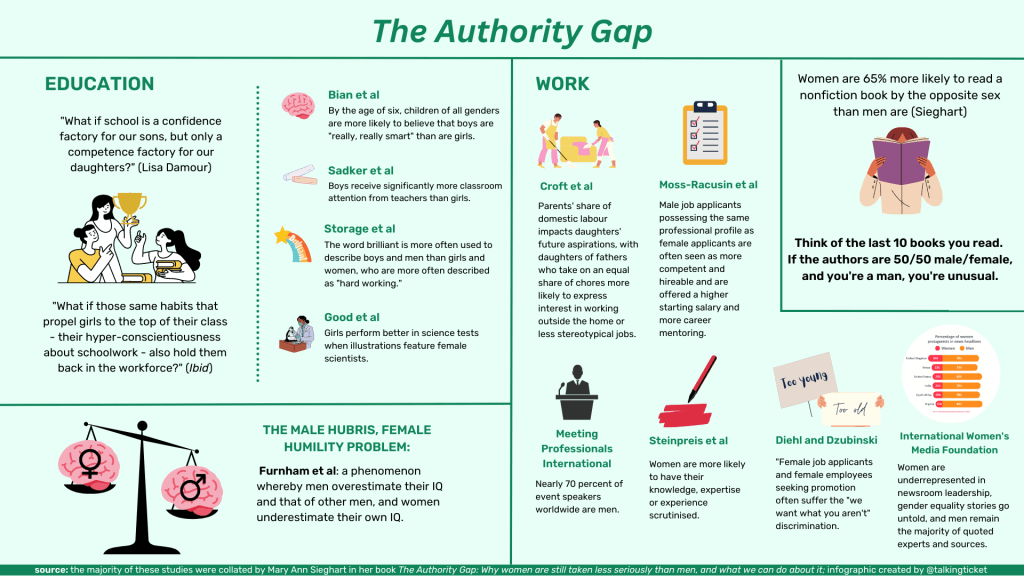
A product of this distinction, along with cultural tropes and bias around who we see as an “expert”, “leader” or “genius,” is the insistence that women “lean in,” Sheryl Sandberg style.

Yet, because women can have very different experiences from men when we do lean in – something that I call “polyglot pain” in the language context – we can again be discouraged, and so the cycle continues.
That is, women remain steadfast at achieving brilliant things, but can be less likely to shout about it.
Womanhood is often perceived as a niche experience, due to the trope that sees men as universal. Reading Caroline Criado-Perez Invisible Women: Exposing Data Bias in a World Designed for Men or a short article summary of it makes this abundantly clear. This then reaffirms stereotypes about who we should listen to and believe, who journalists cite and seek as sources, who event organisers invite to speak and so on.
So what can we do about it? There are plenty of things we can do as individuals to bridge this gap. Here are three priorities:
- Get the lie of the land: read Mary Ann Sieghart’s The Authority Gap: why women are still taken less seriously than men, and what we can do about it, and use Cathy Deng’s Are Men Talking Too Much? tool.
- Read, follow, share and promote women and our work, and engage us in healthy debate.
- Get savvy at distinguishing confidence from competence.
As for women in the language community, have you considered speaking at a language event before? Check out my Language events for your 2023-2024 diary: speak on stage from September post for upcoming opportunities, and read my How I prepared to give a talk at this year’s Polyglot Gathering and what I learnt from it for planning tips.
The long read (13 minutes)
Given the scepticism surrounding the issue, I thought I’d have a debate with the Devil’s advocate, which starts with a simple rejection of the main premise.
Contents
- “That’s rubbish, I’ve seen plenty of female polyglots online”
- “Well, that’s just a marketing thing”
- “That must mean that there are more male experts in the language field than female ones”
- “In that case, women should put themselves forward more”
- “Everyone experiences negativity; it’s just about persistence”
- “But they’re just a minority of weirdos on the internet and assholes”
- “Well, I’m not one of those people, so why does this concern me?”
- “If it’s systemic, then there’s nothing I can do about it”
- Individuals
- Event organisers
- Invited speakers
- “Aren’t you just perpetuating this problem by focusing on it? Things will change over time”
- “I’m going to need more evidence going forward”
- Bibliography
“That’s rubbish, I’ve seen plenty of female polyglots online”
Many female polyglots have emerged online since the early days of Reddit polyglottery, following multiple discussions led mainly by male polyglots about “why there aren’t many female polyglots.” We all know that this is simply the wrong question, the correct one being: “why don’t female polyglots get more air time?”
A simple exercise to test whether this is true is to try to name 10 famous male polyglots right now, who tick all of the following:
- Make the press
- Headline events
- Sell you their products on every social media platform you’re on
Now try naming 10 female ones who do the same (without Google!). Trickier, right?
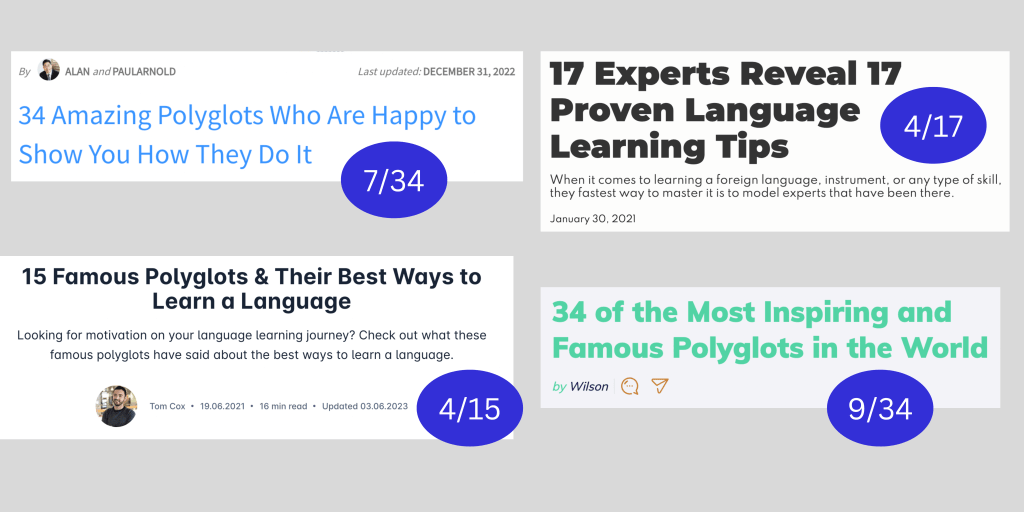
Let’s now see what Google comes up with. Try googling “famous polyglots,” and you’ll find reams of lists from some of the most well-known language learning websites.
Here are a few recent examples from Preply,1 Mosalingua,2 Jump Speak3 and Fluentu.4
In these lists and many others, women and people of colour accounted for very few of the top polyglot spots.
“Well, that’s just a marketing thing”
It sure is, to a degree! If we take those lists of “famous polyglots”, two distinct categories of polyglots emerge: academic experts or “long-term polyglots”, and individuals who fit the hero’s journey framework.
The hero’s journey is used in many industries, where content creators pitch themselves as heroes in the stories of their transformation into experts. In the language context, this regularly plays out as follows:
A monolingual person moves abroad in their early 20s. Tormented by their wretched monolingual upbringing, they are eventually transformed from zero to hero, thanks to their magical learning method, now worth a gazillion dollars.
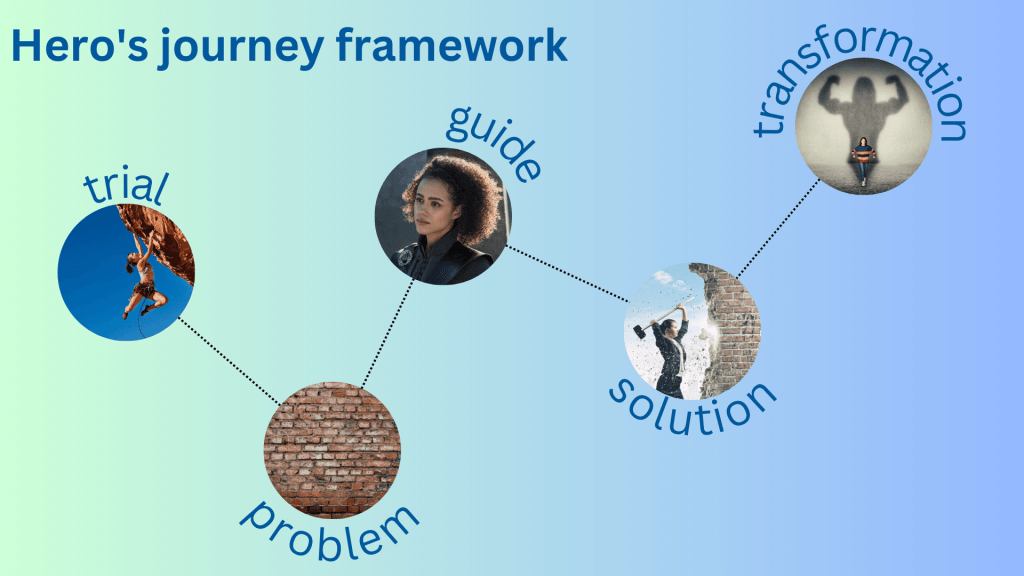
Since women are more likely to study languages through formal education (more on this later), the hero’s journey framework doesn’t always work for our learning stories. Even so, we don’t get many of the “long-term polyglot” slots either.
Of course, we all know the power of clickbaity content, meaning that social media isn’t necessarily a fair space to evaluate authority objectively. And the rise of “Gotcha, fake ‘polyglot!’” videos, is testament to the limits of Youtube as an authority builder.
However, the internet is news is journalism is authority these days. Let’s move away from Youtube and other polyglot party spaces for a moment, towards more traditional bodies.
Unsurprisingly, the media is predominantly made up of men worldwide,5 women are less likely to feature as protagonists in news headlines6 and are significantly less likely to be quoted as sources, or have their work cited as experts, as explored by journalist Ed Yong in his I Spent Two Years Trying to Fix the Gender Imbalance in My Stories article.7

So let’s consider where journalists get these sources from. Nowadays, women publish more books than men,8 although a substantial gender gap in academic publishing remains (with this varying depending on academic field), and almost 70% of all event speakers are male globally.9
Events in the polyglot community are an important space for building authority, and with it being such a small community, familiar faces emerge quickly. Whilst progress has been made at events from the Polyglot Gathering to the Polyglot Conference and more – whereby at some of the first meetings in the early days, female speakers were greatly outnumbered by male ones – events are still not at a 50/50 speaker ratio gender-wise.
This is something that polyglot event organiser Richard Simcott recently addressed in a Youtube live,10 where he explained that he sometimes finds it a challenge to get women to speak at his events.
“That must mean that there are more male experts in the language field than female ones”
Au contraire! The languages industry is overwhelmingly female.
On average across OECD countries, 70% of teachers are women
OECD iLibrary11
Girls and women make up the majority of language students at school12 and university globally, and language-specific careers such as language teaching, translation and interpreting13 are all female-dominated.
If we look specifically at polyglottery, the internet will likely tell you that men are more likely to be polyglots or hyperpolyglots. In fact, I even asked ChatGPT to list the 10 most famous polyglots; 9/10 were men.
Well, guess what? The internet has learnt our bias, partly peddled by self-reporting “science.” Unsurprisingly, voluntary surveys aimed at “the world’s most extraordinary language learners” will attract a certain crowd. Conclusions then emerge that polyglots and hyperpolyglots are more likely to be men. This myth is so enduring that it led the President of HYPIA (The International Association of Hyperpolyglots) to publish an article called Gender and Hyperpolyglotism: Addressing a Myth.14
There is no objective test for what counts as a polyglot or hyperpolyglot. All we can go on is people’s accounts of their own abilities. The exception to this is HYPIA, which requires applicants to be fluent in a minimum of 6 languages in most cases, which is then tested by a panel of current members (under what rubric, is unclear). The word “fluent” is similarly vague to discussions around what counts as “speaking” a language, meaning, again, we’re going on what people claim, followed by the interpretations of the panel in question.
“In that case, women should put themselves forward more”
Ah, the old “lean in” advice. Women are often told that we should simply “lean in”, Sheryl Sandberg style,15 which is a short-hand for “seize every opportunity with confidence”.
When someone asks me whether men are more likely to be polyglots than women, my simple answer is that they’re more likely to claim to be polyglots, and in turn are less likely to have that label questioned than women are. As such, polyglot and hyperpolyglot spaces become overpopulated with men, which can deter women from approaching the spaces, and so the cycle continues. For example, only 28% of HYPIA is female. Drawing the conclusion that men are simply more likely to be hyperpolyglots as a result of this data ignores other factors from the varying measurements of fluency, not feeling aligned with the values of the organisation or it could be linked to the fact that men apply for a role when they meet only 60% of the qualifications, but women apply only if they meet 100% of them16.
Negotiating terms like “fluent,” “polyglot” and “hyperpolyglot”, married with the desire to get publicly “accredited” requires that people who identify with such terms are not simply competent but are purely or also incredibly confident, or at least perceived to be so.
Confidence is something that is built over time, and is also hampered significantly under poor conditions. This concept makes up part of “The Authority Gap”, a term coined by writer Mary Ann Sieghart.17 It shows that confidence and perceived authority sit on a two-way street, with others’ perceptions of someone’s competence often leading to an increase in confidence. Similarly, others’ disregard of someone’s authority can lead to a decrease in confidence over time.
Repeated messaging is powerful and considering the consistent messaging girls and women get throughout their academic and professional careers, it’s unsurprising that they may be more hesitant about publicly promoting their expertise.
“Everyone experiences negativity; it’s just about persistence”
Of course no one lives in a vacuum of positivity, but when it comes to how much negative messaging and treatment impacts us, we need to consider: a) how much negativity b) what kind c) on what basis d) what scope we’re given to move forward
In her book Failosophy,18 British writer and journalist Elizabeth Day discusses her initial search for guests on her How to Fail podcast,19 which has celebrity guests discuss three failures and what they learnt from them.
Day describes a fundamental difference in attitudes and perceptions of failure between the men and women she approached, saying that all of the women really struggled to whittle down their failures to just three, whereas most of the men expressed hesitancy at featuring on the podcast, because they weren’t sure they’d ever failed.
Such a stark gender difference in our relationship with failure is unsurprising considering Sieghart’s findings. And despite the barriers, women do persist, in general and specifically in the polyglot world, disproportionately grappling with what I call “polyglot pain”:
Testimonies of female polyglots online echo these; here are some examples:
Polyglot Youtuber Emily Harris20 has explained that the “go and immerse yourself” advice wasn’t the rosy solution to learning a language she thought it would be. Whilst studying abroad in various European countries, she regularly experienced personal interrogations regarding her identity, as people would simply not accept her answer to the question “where are you from?” The immersion advice also fails to account for income disparities; since factors such as gender, ethnicity and disability can impact earning potential (consider the respective pay gaps21), language immersion is not an equal opportunity for language learners.
The online whilst female problem is no secret either; Lindie Botes22 has discussed the abuse she has suffered as a polyglot content creator, and Scots language advocate Len Pennie regularly uses the misogynistic comments she receives as material for her poetry.23
The resilience and determination required in the face of these barriers are important teachable qualities, and equally as important, we need to bring these issues to light, if we’ve any hope of eradicating them.
“But they’re just a minority of weirdos on the internet and assholes”
It’s not just an underground minority who fails to acknowledge women’s contributions as valid and worthy of authority and credit.
A particularly telling account is that of writer Catherine Nichols,24 who explains that “To some degree, I was being conditioned like a lab animal against ambition,” after doing an experiment following a series of rejections. Frustrated that so many agents refused to even read her pitch for her novel, Nichols changed the name on her manuscripts to a man’s: George. Nichols explains that the process revealed to her that George “is eight and a half times better than me at writing the same book”, referring to the increase in agents who agreed to read “George’s” manuscript compared to hers. Even the rejections had better results, where she received compliments, as well as coaching and feedback.
“To some degree, I was being conditioned like a lab animal against ambition.”
Catherine Nichols
Whether we’re talking about labelling ourselves a certain way, as “experts” or “polyglots”, or putting ourselves out there for potential rejection, it’s clear that for many reasons, the stakes are higher for women. If the worst thing a man gets from a failure, setback or rejection is feedback, coaching or encouragement, then the gains outweigh the losses. Women simply don’t benefit from this as often.
“Well, I’m not one of those people, so why does this concern me?”
If someone were on fire, would you not help them because it wasn’t you who lit the match? This is a systemic issue across all industries and societies, and it manifests in many ways:
- Perceived niche experiences: women’s experiences are perceived as niche, only appealing to other women, whereas men’s are perceived as universal: this goes part way to explain why women are 65% more likely to read a nonfiction book written by the opposite sex than men are.25
- Funding bias: Female polyglots may have a harder time even funding (a) product(s) they’d like to sell online due to gender bias in investing: women entrepreneurs receive less than half of the investment capital than their male peers.26
- Cultural tropes and bias in leadership: Cultural tropes that associate men with taking charge and women with taking care – coupled with the status incongruity hypothesis27 – lead to a preference for seeing men in leadership roles over women,28 making us more likely to listen to and believe men.
- Scrutiny and abuse: Women are less likely to put themselves out there online or at events due to the increase in scrutiny, criticism and abuse levelled at women compared to men, with Wired magazine concluding that “unless we act, 2023 will be the year that women leave the internet.”29
- Confidence gap: the literature is split on this. Some theorise that women may have less confidence than their male peers30 whilst others see the confidence gap as a myth.31 The effects of both theories result in red herrings for women’s progress anyway, where women remain stalled for being “too confident,” “not confident enough,” or simply plagued by “we want what you’re not” discrimination.32
If you’re still not convinced by the validity of these phenomena, read Chapter 5 of The Hidden Brain,33 in which transgender people share their stories of increases or decreases in respect, salary, job opportunities and more, depending on which way they transitioned.
“If it’s systemic, then there’s nothing I can do about it”
Individuals
Actually, there are things we can all do to create a more egalitarian way of doing things. Here are some starting points:
- Pay attention to who we read, follow and interact with online in order to diversify our sources of inspiration and knowledge.
- Notice if we are challenging women more than men or questioning their expertise more, and challenge this bias if so.
- As content creators, we must actively promote and celebrate the contributions of female and non-binary polyglots, amplifying their voices and experiences.
- We all need to get better at: distinguishing confidence from competence, prioritising the latter and simply stop talking about confidence altogether.
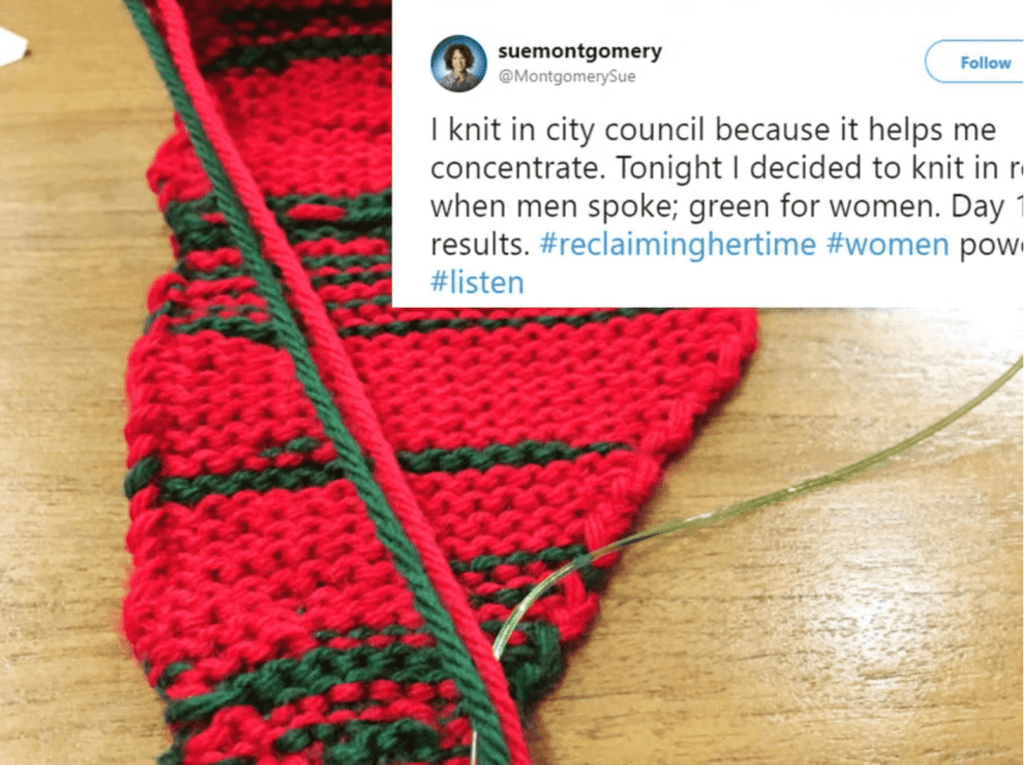
“Inclusion is more nuanced than knowing who’s in the room, because not everyone has equal power or visibility. Often, even in rooms that seem gender-diverse, men still dominate conversations to a large extent.”
Cathy Deng36
Event organisers
And for event organisers: simply refer to the Brussels Binder toolkit,37 created as part of a project that aims to raise the visibility of women in debates regarding policy-making in Brussels.
Invited speakers
If you’re asked to speak at an event:
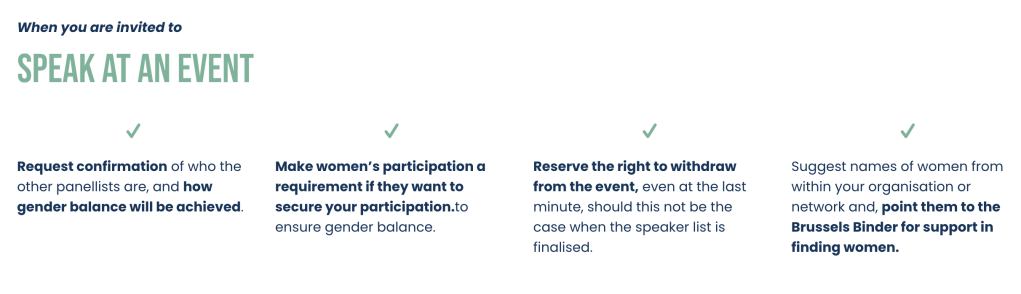
Whether you choose to speak or not, pay it forward; suggest women you know to be approached, or encourage them to apply to speak.
“Aren’t you just perpetuating this problem by focusing on it? Things will change over time”
Firstly, the UN estimates that if we do nothing to balance the scales, we will not achieve gender equality for another 300 years.38
Secondly, whilst drawing attention to these issues can feel like another cross for women to bear, I think it’s important to take into consideration, if only as proof that IT’S NOT YOU, if you find yourself being criticised, scrutinised unduly, or harassed.
“I’m going to need more evidence going forward”
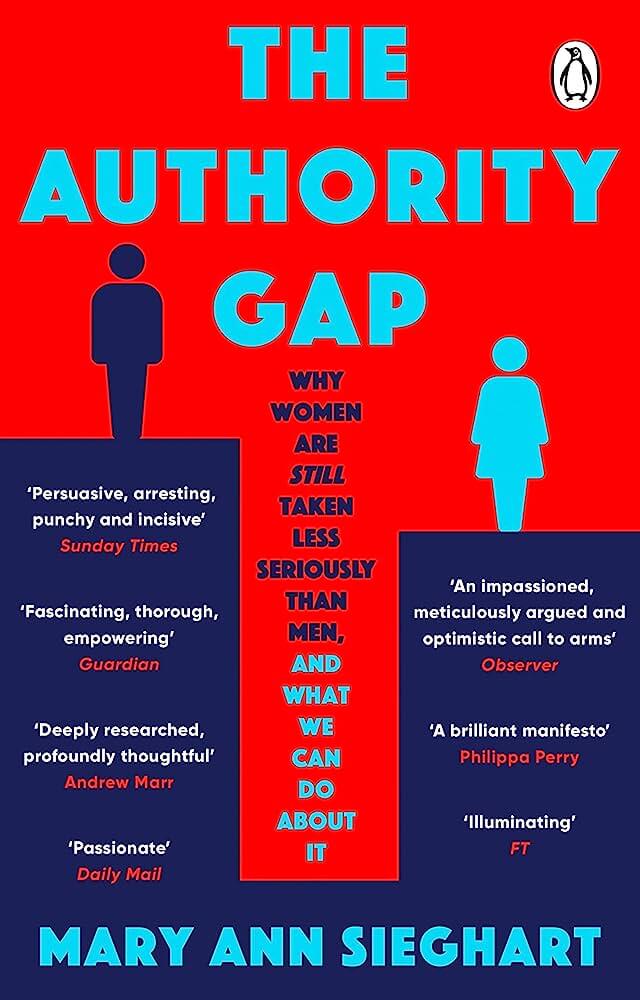
No problem. I highly recommend Mary Ann Sieghart’s The Authority Gap: Why women are still taken less seriously than men, and what we can do about it.39 It is a watertight look at the current state of gender play, backed up by reams of hard data.
Is this something that resonates with you? Is there anything else you think we can do to bridge this gap? Comment below!
Bibliography
- https://preply.com/en/blog/polyglots/ ↩︎
- https://www.mosalingua.com/en/famous-polyglots/ ↩︎
- https://www.jumpspeak.com/blog/language-learning-tips-from-experts ↩︎
- https://www.fluentu.com/blog/polyglot-language-learning/ ↩︎
- https://reutersinstitute.politics.ox.ac.uk/women-and-leadership-news-media-2022-evidence-12-markets#header–6 ↩︎
- https://www.iwmf.org/missing-perspectives/ ↩︎
- https://www.theatlantic.com/science/archive/2018/02/i-spent-two-years-trying-to-fix-the-gender-imbalance-in-my-stories/552404/ ↩︎
- https://www.weforum.org/agenda/2023/03/women-are-now-publishing-more-books-than-men-and-its-good-for-business ↩︎
- https://www.bizzabo.com/blog/event-gender-diversity-study#dropdown ↩︎
- https://www.youtube.com/watch?v=8W9i70bBAzo ↩︎
- https://www.oecd-ilibrary.org/sites/145d9f68-en/index.html?itemId=/content/component/145d9f68-en ↩︎
- https://www.britishcouncil.org/contact/press/new-report-reveals-stark-gender-gap-foreign-languages ↩︎
- https://www.conferenceinterpreters.co.uk/2018/03/17/uncategorised/gender-parity-and-the-winners-are/ ↩︎
- https://papers.ssrn.com/sol3/papers.cfm?abstract_id=3761951 ↩︎
- https://leanin.org/book ↩︎
- https://hbr.org/2014/08/why-women-dont-apply-for-jobs-unless-theyre-100-qualified ↩︎
- https://www.maryannsieghart.com/the-authority-gap/ ↩︎
- https://www.elizabethday.org/failosophy-handbook-things-go-wrong ↩︎
- https://open.spotify.com/show/4m7U7kNne0iu35HK571Ui8?si=d9ef3f1f6b3a4f69 ↩︎
- https://www.youtube.com/watch?v=634FREd89sg ↩︎
- https://equality.leeds.ac.uk/wp-content/uploads/sites/64/2023/03/Pay-Gap-Report-2022.pdf ↩︎
- https://www.youtube.com/watch?v=v8k4H6CCZD4 ↩︎
- https://www.tiktok.com/@miss_punnypennie/video/7234649417351957786 ↩︎
- https://jezebel.com/homme-de-plume-what-i-learned-sending-my-novel-out-und-1720637627 ↩︎
- https://www.maryannsieghart.com/the-authority-gap/ ↩︎
- https://eca.unwomen.org/en/stories/news/2022/05/investment-in-womens-entrepreneurship-is-an-investment-in-change ↩︎
- https://www.sciencedirect.com/science/article/abs/pii/S0022103111002514#:~:text=The%20status%20incongruity%20hypothesis%20(SIH,so%20defends%20the%20gender%20hierarchy. ↩︎
- https://www.ncbi.nlm.nih.gov/pmc/articles/PMC8187584/ ↩︎
- https://www.wired.co.uk/article/women-internet-harassment ↩︎
- https://www.futurelearn.com/info/courses/understanding-gender-inequality/0/steps/66852 ↩︎
- https://hbr.org/2018/03/is-the-confidence-gap-between-men-and-women-a-myth ↩︎
- https://www.bizjournals.com/bizwomen/news/latest-news/2023/06/these-are-the-30-critiques-holding-women-back-from.html?page=all ↩︎
- https://eddierockerz.files.wordpress.com/2020/11/the-hidden-brain-how-our-unconscious-minds-elect-presidents-control-markets-wage-wars-and-save-our-lives-pdfdrive-.pdf ↩︎
- https://www.bbc.com/news/blogs-trending-48278772 ↩︎
- http://arementalkingtoomuch.com/ ↩︎
- https://www.genderavenger.com/blog/are-men-talking-too-much ↩︎
- https://toolbox.brusselsbinder.org/gender-balance/ ↩︎
- https://feature.undp.org/gender-inequality-2023/ ↩︎
- https://www.maryannsieghart.com/the-authority-gap/ ↩︎


Leave a comment