

They taught you that words ending in “a” in Spanish are generally feminine, so what’s with the abundance of exceptions? Luckily for Spanish learners, there are a series of tricks to work out the gender of most words ending in “a”.
As a general rule, you can divide Spanish words that end in “a” into two categories:
- Words ending in “a” of Greek origin = masculine
- Words ending in “a” of Latin origin = feminine
If you don’t speak Greek (me neither), you are probably wondering – how the hell do I tell? Luckily, many of these are cognates in English, meaning that we can spot them pretty easily as English speakers. This is less the case for Latin words (though of course, there are exceptions).
The two most useful categories of words of Greek origin to consider are the following:
| Words of Greek origin: masculine words | |
| Spanish words ending in “-ta” | el dentista* = dentist el atleta* = athlete el artista* = artist el activista* = activist el alpinista* = mountain climber el planeta = planet |
* -ista actually has dual origins in Latin (-ista) and Greek (-ιστής: -istḗs), but since these words are masculine, it’s easier to associate them with the Greek. They can be feminised when referring to women in the role by switching “el” for “la”: la dentista = female dentist
| Words of Greek origin: masculine words | |
| Spanish words ending in “ma” | el problema = problem el trauma = trauma el teorema = theorem el pirata = pirate el tema = theme el poema = poem el aroma = aroma el carisma = charisma el clima = climate el sistema = system el fantasma = ghost/phantom el lema = slogan el idioma = language el drama = drama el dilema = dilemma el mapa = map el holograma = hologram el diagrama = diagram el programa = programme el anagrama = anagram |
That all sounds pretty easy, I hear you say! However, whilst words ending in “grama” are a safe bet as words of Greek origin, and whilst you can generally conclude that if it looks like an English word, it’s masculine, there are a number of Spanish words that end in “ma” that are of Latin origin, some of which are also English cognates. Great.
What would a language be without exceptions? Answer: Esperanto. Let’s master Spanish first, though.
| Words of Greek and Latin origin: feminine words | |
| Spanish words of Latin origin ending in “ma” *English cognates | la víctima* = victim la goma = rubber la llama = flame la pluma = feather / pen la paloma = dove / pigeon la norma* = standard / norm la gema = gemstone la rama = branch la palma* = palm |
| Spanish words of Greek origin ending in “ma” | la estratagema = stratagem/ploy |
| Spanish words of Greek and Latin origin | la dieta |
There are some other things to consider in this department; some words of Latin origin are feminine, but take the masculine article “el” in the singular (but keep “las” in the plural) for melodic reasons relating to the fact that the first syllable of each word is the stressed syllable. Saying “la‿alma” is rather ugly and breaks the flow (which is why the French merge such cases: l’âme):
| Feminine words of Latin origin ending in “ma” that use “el” | |
| El alma = soul | Las almas |
| El arma = weapon | Las armas |
| El ama = homemaker (f); house wife | Las amas |
| El águila = eagle | Las águilas |
In such cases, you match adjectives to the gender of the word, not the article: “El alma hermosa” = the beautiful soul.
Here’s a visual to simplify things.
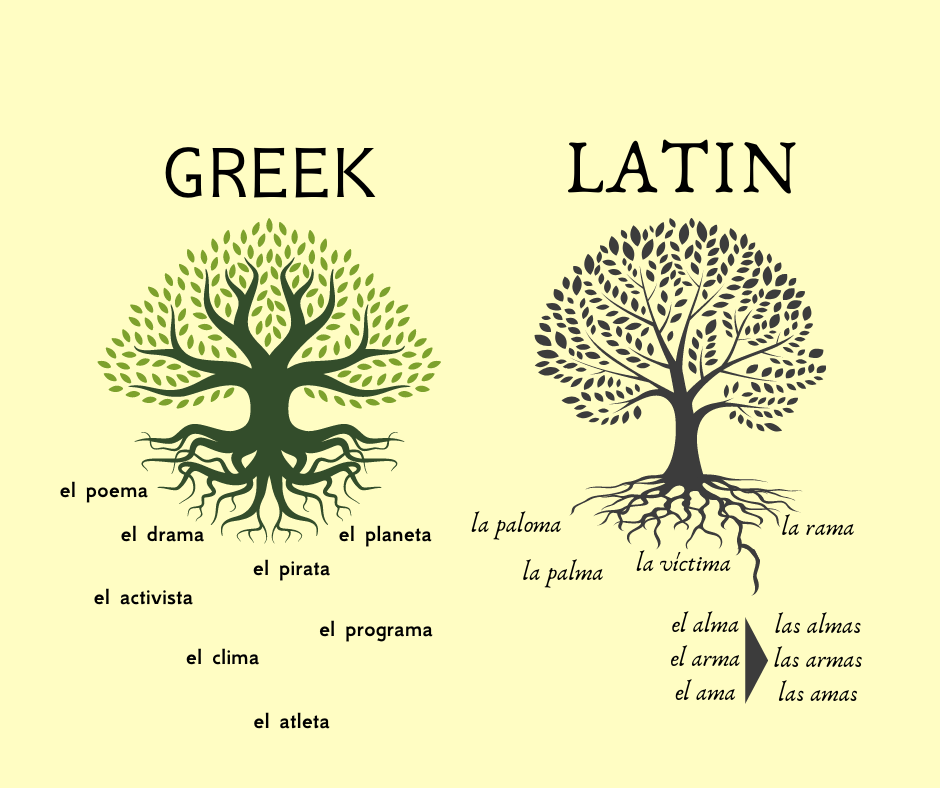
After reading this, “it’s all Greek to me” may take on a whole new meaning!
If you’re relatively new to language learning, then this might seem like a lot of work and something that no one would realistically rely on.
However, it’s a really popular polyglot hack, which will quickly have you sounding like a language expert.
If this is a method that works for you, check out Spanish: Fast Track Learning with Root Words for English Speakers: Boost your Spanish vocabulary with Latin and Greek Roots! Learn one root and you´ll learn many words in Spanish by Sarah Retter.

Were you aware of this? Does this help with your learning of just confuse you more? Comment below!
MORE LIKE THIS ›


Something went wrong. Please refresh the page and/or try again.


Leave a comment