

The Lingoda language sprint is the uberfication of language learning 🚕
The sprints consist of group online classes delivered on Zoom, with native-level teachers. Classes are available at all times of day, suiting all time zones.
If you’re already familiar with the Lingoda language sprints, you can skip to my take on completing the regular sprint; otherwise, keep reading for a rundown of the practicalities.
Practicalities
There are two sprints available for English, French, Spanish, Italian and German; the regular Sprint and the Super Sprint:
Regular Sprint: take 15 classes in Month 1 and 15 classes in Month 2.
Super Sprint: take 30 classes in Month 1 and 30 classes in Month 2.
The sprints only run at certain times of year, so it’s worth keeping an eye on the website to make sure you sign up in time.
Cost
The price varies per sprint (regular or super) and language, and is constantly fluctuating. Check the most up-to-date prices here.
The greatest selling point of the Lingoda sprints is that if you complete your sprint in line with the rules, you are entitled to 50% of your money back, or a higher value of course credits for the future.
Rules
There are a number of rules; these are the most notable ones:
- You must take group classes (they never include more than 4 other students)
- You must take the exact specified amount of classes (regular sprint = 15/m; super sprint = 30/m) within the two months that the sprints are on (as specified on the website)
- You can’t take more than one class a day, and more than 5 classes or 7 classes a week for the regular sprint and super sprint respectively
- You can’t miss more than 10 minutes of any class
- You can change the level of your classes mid-sprint, but not the language you’re learning
- You can either follow a course curriculum (advisable for lower levels) or choose classes at random (see how to book classes here)
Read about the other rules here.
Levels
Lingoda follows CEFR, and levels are then further divided, split in two for levels A1 and A2, and into three for levels B1 and B2.

It’s worth noting that the sprints are designed to convince you to sign up for more lessons in the future. For example, I signed up to learn German at A2.1 level; under this level, in order to get a certificate, or to consider the course “completed”, you need to take 45 out of the 50 classes in the curriculum.
This means that if you do the regular sprint (take 30 lessons over two months), you won’t complete the whole sub-level. This may be deflating for some people, but remember it’s just a marketing technique!
You’ll learn loads over 30 lessons in two months; compare this to weekly evening classes, which amount to 8 classes over two months. Chalk and cheese!
My take
Quality of lessons and teaching
The structure of the course is very good; expect to learn all the necessary grammar rules and lots of useful vocabulary for the particular CEFR level you’re working at, but bear in mind that you’ll rarely say more than one sentence at any given time in class.
Also note that the lessons are very formulaic; if you’re someone who needs a lot of variety in your learning, Lingoda won’t necessarily suit you.
You can access all of the material of your level at any point after signing up for the sprint, so can save it for your personal use later, or study independently for some lessons so as to get through more material than you have class credits.
The teachers are supposed to stay in the target language for the majority of each lesson, though sometimes switch to English when there are real issues with communication. Each teacher interprets this in their own way, of course, and you get to review the teacher and material after each class.
All the teachers I’ve had so far have been great; it’s not easy to create a lively and engaging environment in a class of strangers online, but they do a brilliant job.
Effectiveness
I have only attended the sprint for German at A2.1 level, so my experience is specific to that. For me, the sprint is an incredibly effective kickstarter. It got me speaking full sentences with relative confidence.
The teachers do a great job of creating a welcoming atmosphere in each class, but since you get a different teacher and a different set of fellow students each class, you don’t build up a rapport like you would in a regular class. This may be a plus for some people who quickly get sick of that one student who’s hogging all the talking time, or that other student who refuses to speak at all during pair work… The structure of the lessons demands a good pace, meaning you’ll experience no dead time.
I personally wouldn’t do a sprint if I was working at a B2 level or above, as I’d want the opportunity for more talking time and creativity, but to snap you into action anywhere from beginner to B1, it’s very effective.
If you’ve got very specific goals regarding knowledge of grammar and improving your vocabulary at a higher level, however, Lingoda may still be a solid option.
Value for money
If you complete the sprint in line with the rules, and as a result get 50% of the course fees back, then the sprint is a bargain indeed.
At one point the regular sprint for English, French and Spanish only cost €331 up front, which amounted to €165.50 after a 50% refund, and thus €5.52 per class when spread across the 30 lessons of the sprint. What a bargain!
It takes a little over a month for the Lingoda team to review the sprints after completion, so expect to wait for a period before you get your cash back.
My recommendations
Don’t bother doing the orientation class: there’s the option of doing a class to introduce you to the methodology and format of the course. I attended but I don’t think it’s necessary; it counts towards your sprint and it’s better just to jump straight into the learning.
Choose the lessons you attend really carefully: there are fives categories of lessons: vocabulary, communication, grammar, speaking, reading. I recommend skipping the reading lessons, as you can do this independently (you still get access to the material).
Also, I stopped attending the vocabulary lessons in month 2, as I knew I could just review the lesson material of each new topic on my own. As such, I prioritised communication, grammar and speaking. You get the most out of grammar lessons because you can have your questions answered by the teacher, and communication and speaking are more useful than reading, because we generally feel more weird speaking alone than we do reading, for example!
Also, schedule grammar lessons on days you know you’ll have more energy. I learnt this the hard way!
Check your tech: if you miss a class due to a technical glitch, that’s a you problem and it will ruin your sprint, so always have your phone hot spot at the ready for back up, should your wifi go down.
Make notes: I made notes in every class I did; this was really useful for solidifying my knowledge, having something to come back to in future lessons, as well as giving me proof I’d learnt A LOT over the two months, as the material spanned across a good 40 pages of A4 💪
Document the journey: record yourself speaking at different stages of the sprint, as evidence as to how far you’ve come. This can be video form, or audio, whether to yourself or someone else.
The sprint gave me the confidence to start sending audio messages to some of my German-speaking friends, which was great practice for spontaneous and informal chat, and it led to feedback and tips from my fluent friends.
Final thoughts
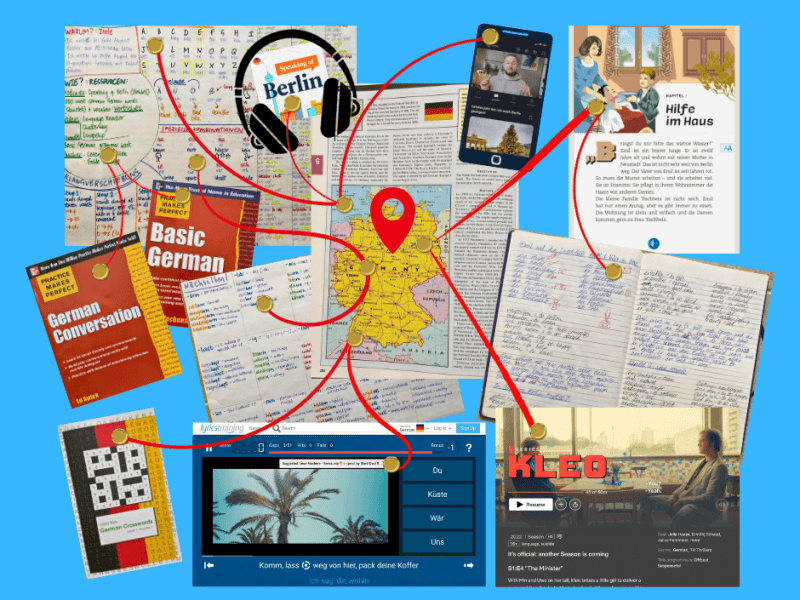
It’s crucial not to see the Lingoda sprint as a silver bullet; I did a lot of other stuff outside of the classes that boosted my learning too, including:
- Sending audio messages in German to my friends.
- Reading and listening to German graded reader stories, writing chapter summaries in German for what I’d read, and writing “what I’ve understood” lists in English for what I’d listened to.
- Completing grammar exercises in Practice Makes Perfect workbooks.
- Doing extra online research and making notes on particularly difficult grammar points (German cases!!).
- Listening to German podcasts (check out my 10 great podcasts with free transcripts for A1-B2 German learners post).
- Watching German TV series and films (read my 9 highly entertaining Netflix German series worth watching post).
- Following and watching German language Instagrammers.
Towards the end of the two months I was very ready for it to be over because it is quite intense, but it felt like a graduation and like I had been given the tools to try something different at a higher level, like booking 1-2-1 classes on Italki now I feel I can form full sentences!
The format didn’t convince me to sign up for a regular subscription, only because I thrive on variety and creativity, but it will work for others.
I would absolutely recommend Lingoda to anyone wanting to jumpstart their progress in the early stages of learning a foreign language.
If you’ve tried Lingoda before, let me know what you thought of it in the comments!





Leave a comment