

In my early 20s, I packed my bags and headed to Ghent for a year-long post in a Flemish NGO, under the EU-funded European Solidarity Corps programme.
As part of the programme, I was entitled to 3 months of Flemish lessons. I signed up to a semi-intensive course of 6 hours per week, spread over two evenings, convinced I’d be fluent in no time.

Oh. how. wrong. I. was.
My failure to learn Flemish has since informed my language learning. If we know what the traps are, we can take steps to avoid them!
Here are 10 ways not to learn a foreign language effectively:
Don’t set a SMART goal
Going through the motions of a course (I got through levels A1.1, A1.2 and A1.3) is enough to constitute a SMART goal, right? WRONG!
I put my learning in the hands of the teacher, figuring I would be taught to speak Flemish, when I needed to get in the driver’s seat and actively learn Flemish.
My only goal was to turn up to class twice a week, and I didn’t even stick to that. A goal as simple as “have a 15-minute conversation with a Flemish person by [X date]” would’ve been a good start.

Make friends in the wrong language(s)
The languages of my organisation were English and Spanish, and I met lots of people fluent in both languages as a result. I built a rich social life off the back of this, and as such I didn’t feel a social incentive to learn, not to mention the fact that the Flemish quite enjoy the opportunity to speak English.
Don’t do any research on the language
Something that I found particularly challenging was my teacher’s explanation that a double-consonant will dictate the length of a vowel sound: the word “tree” in Flemish is “bomen”; add another “m” to make “bommen”, which means bomb or bombing. The irony is that “bomen” sounds similar to the “o” sound in “bomb” in English, whereas “bommen” sounds more like the “o” sound in “boat”. This was mental to me.
Then, some way through the process, I realised that English shares this characteristic, but the pattern is inverted. One consonant will create a long vowel sound: “hoping” (“hooooooping”), whereas two will create a short one: “hopping” (“hOpping”).
If I’d done my research, I would’ve found that this is one of many shared characteristics between Dutch/Flemish and English. Others include:
- Compound nouns: workplace → werkplaats, dry-clean → droogkuis
- Cognates: friend → vriend, dream → droom, better → beter
- Phrasal verbs: to search for → zoeken naar, to care about → geven om)

If I’d known how linguistically close Dutch is to English, and hadn’t internalised the myth that “Dutch is a really hard language,” I would’ve felt much more motivated.
Don’t find any way to connect to the language
I remember my Flemish teacher playing our class a traditional Flemish song, which I found interesting, and which also reminded me of The Wurzels, a country band from my native Somerset. It didn’t speak to me in any real way, and since mainstream music is so popularly sung in English, I figured that Flemish music wasn’t for me. Note to self: listen to more than one song.
Whilst I very much connected with Belgian cuisine and beer, I did more tasting than researching to improve my Flemish… Saying lekker when you break bread or saying proost over beer is a day-one accomplishment that should quickly be expanded upon.

There are also plenty of Dutch and Belgian films and series on Netflix that I could’ve watched… but didn’t…
For more ideas on how to connect to a language and culture, check out my How to start learning any language: treat it like a crime you’re trying to solve post.
Make a native friend who can do all the translating for you
I have no regrets on this one, as I made a friend for life, with a local, with whom I connected through our love of the Spanish language, amongst other things. It meant we’d make Mexican food together and listen to Latin American music in each other’s company, instead of focusing on Flemish life.
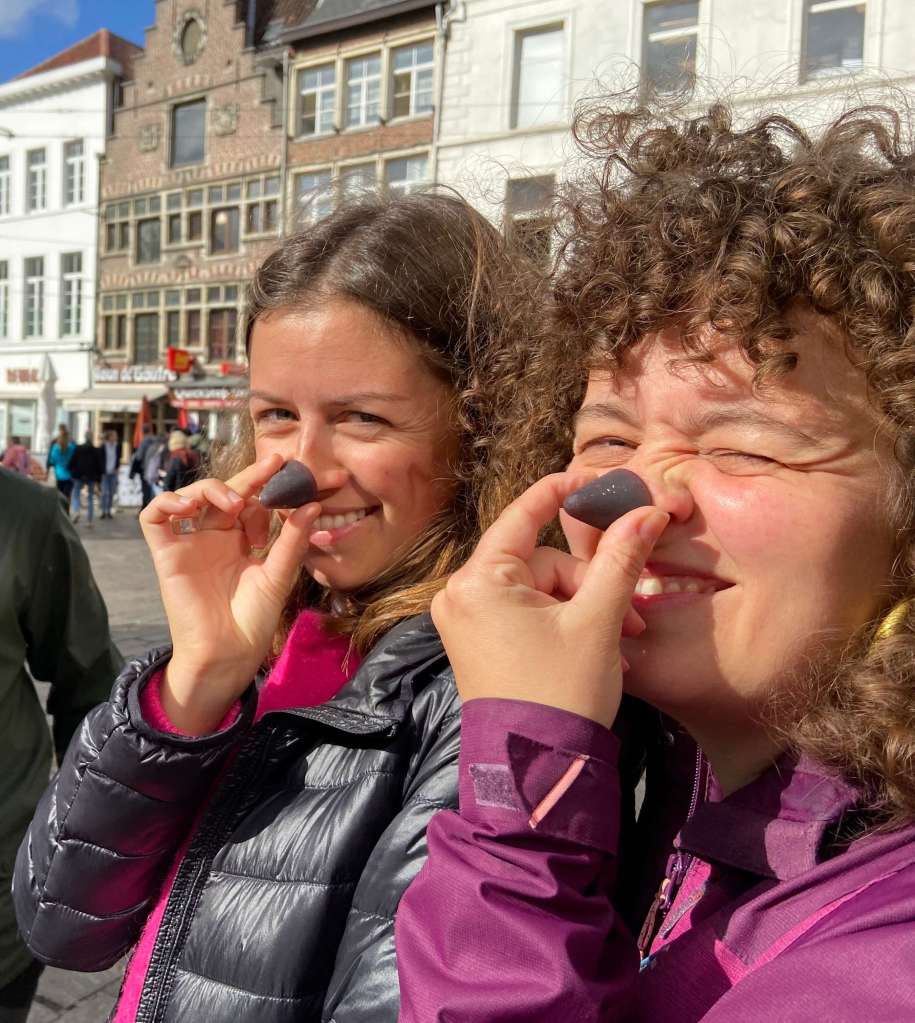
She was also my translator whenever we went out, which gave me the illusion that I was living a Flemish life just by witnessing interactions between Flemish speakers.
A missed opportunity for sure, as making a native friend in your host country when you can barely speak a word of their language is an allusive thing!
Bite off more than you can chew
A weekly six hours of a language I wasn’t enamoured of was very much more than I could chew.
I skipped class more than once and even left midway through a lesson one evening because I’d fallen off my bike on the way to class and couldn’t concentrate.
That I’d got my bike tyre stuck in a tramline was probably some kind of Flemish rite of passage, of course, and a lesson I only needed to learn once (thanks to the embarrassment and pain!). When you cross tramlines on a bike, twist that wheel 90 degrees left or right!

Piss off your teacher
The third teacher we had (for A1.3) was a Ghentian. For some unbeknownst reason (nothing to do with my lack of commitment…), he did not like me. I know this because, suspicious of the way he spoke to me compared to the other students, one day I asked two of my classmates in the break whether they’d noticed this. They had.
I managed to damaged my reputation even further in his eyes when, on the day I was due to deliver a presentation on a famous Belgian of my choosing, I had to admit that the assignment had completely slipped my mind and I had nothing prepared. Could I please do it next week. He was NOT impressed. He told me I could do it the following week, but in not presenting on my allotted day, I would automatically be able to score a maximum of 50%.
Determined to prove I wasn’t a complete imbecile, I put my all into my presentation of a woman called Hélène Dutrieu, who, born in 1877, lived many lives, as a professional cyclist, motorcyclist (performing stunts on both), a pilot, a director of a military hospital and later a journalist, amongst many other things.
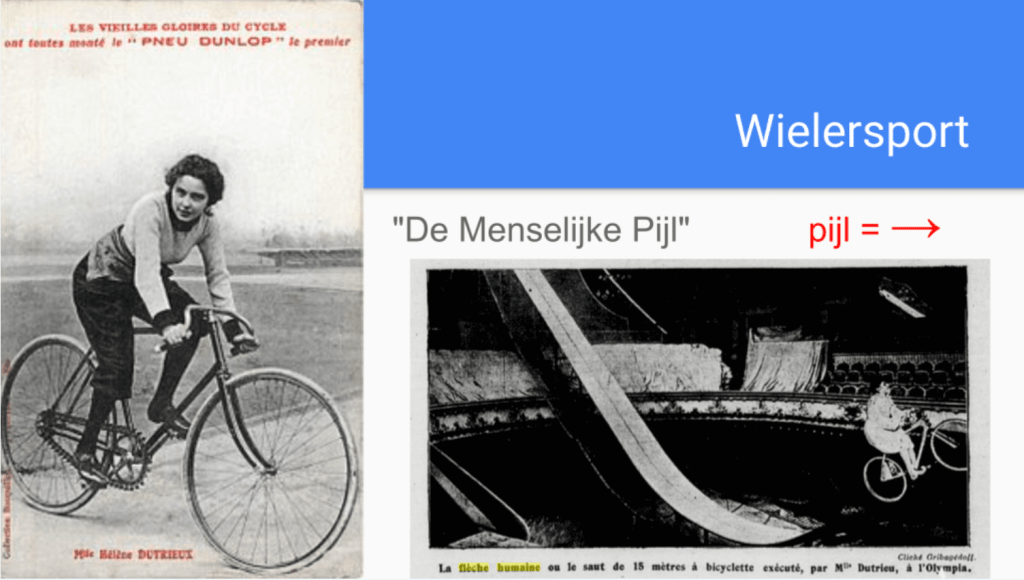
Through her cycling she became known as “The Human Arrow”, and as a result of her piloting “The Hawk Girl”. In 1913, she became the first woman aviator awarded membership of the Légion d’honneur. What a legend!
Lo and behold, my teacher gave me 50% for my presentation, as expected. I couldn’t help but ask him what I would’ve got if I’d done the same presentation the week before. He begrudgingly told me 18/20. Score!
He got his final knife in, however, in the end of unit test where, when I asked him why I’d got such a low mark in the writing task – displaying the classic symptoms of the Dunning-Kruger effect – he told me that what I’d produced was well-below the expected standard of a student at my stage. Burn!
Naturally, when you don’t have a good relationship with a teacher, it will stall your progress.
Invest in the feelings of negative encounters in the language
On a trip to the post office for a work errand, I addressed the post office worker in English, as what I needed doing was far beyond the “Are you married?” level Flemish I possessed. Grumpily, she said “You should really make an effort to speak in Flemish, don’t you think?”, accompanied by a look of seething hatred. I felt my face go bright red, and my body fill with anglo-shame.

On my next visit, I was waiting in the queue, praying I wouldn’t get served by her. No such luck. I approached the counter, and addressed her with my rehearsed Flemish. She replied to me in English. I answered her question in Flemish. She stopped what she was doing, stared straight at me, and said, irritated, “English or Flemish?!”. “English,” I conceded.
Returning to my office, I explained the fiasco, to which my boss said, “oh her, Lucy, don’t take it personally. She’s the rudest woman I’ve ever met and she’s horrible to everyone.” My boss was Flemish.
Even knowing that the encounter was a “her problem,” it really put me off trying to speak in Flemish from that point forward. Three lessons:
- Never expect a positive encounter at any post office (shudder from memories of post office visits in Italy).
- Don’t let some rando hamper your language journey.
- Sort encounters in your target language into: a) helpful critique e.g. “Actually, it’s pronounced […]; make sure to stress the […]” 2) hurtful comments e.g. “That’s not how you say it. Your accent is so […]”, and forget the latter.
Don’t find your WHY
Your “why” behind any goal is hugely important. This can look like:
- To communicate with my friend(s), relatives, in-laws, partner in their native language
- To get a particular job/have access to the job market in X community/country
- To learn more about the history/culture of X
- To be able to integrate in my community
- To connect to my ancestry
I had a year-long contract in Ghent, and so realistically had no way of knowing how long I’d stay in Flanders. Most jobs in my remit in Belgium were in French-speaking Brussels anyway, so I just didn’t know why I was learning the language.
Final thoughts
I returned to England for some years following the year I spent in Ghent, despite multiple attempts to stay. It turns out that being a fluent English speaker with poor French and no Flemish doesn’t make you a desirable candidate in the job market in somewhere as multilingual as Belgium..!
If I’d managed to stay, I like to believe I would’ve found my way to speaking some half decent Flemish, but who knows. Either way, the experience was a very useful lesson that helped me reach fluency in French and that I will apply in my quest to learn German, my current project.
Not to mention the fact that I lovedddddd living in Ghent, and I regularly go back for the odd weekend, to enjoy the many activities the city has to offer (check out my A weekend in Ghent: 21 quintessentially Flemish things to do post), as well as to consume all the Ghentian delights (check out my Where to eat and drink over a weekend in Ghent: 20 cafes, bars and restaurants post).
The key thing to remember when it comes to living overseas is not to beat yourself up about falling into the classic “foreigner abroad” traps; we’re all susceptible to them and it’s not the case that you only get one shot at learning a foreign language when living overseas.
And we shouldn’t put ourselves under pressure to be using every waking moment to live more foreignly… It’s ok to have respite in our native language or another language we feel comfortable in, in order to recharge our batteries for a renewed mission to learn that language!
Artwork by Eddy @ craftymommy.jpg.

Does this post resonate with you? I’d love to hear your stories of falling into the “bad foreigner” traps!


Leave a comment