

I recently listened to the “Americans in Paris” episode of This American Life, in which comedian David Sedaris talks about his experience learning French in Paris, which he explores more fully in Me Talk Pretty One Day.
Sedaris explains that he maps out Paris according to where people are most cruel to him, versus where they aren’t.

This got me thinking; my difficult experiences of learning a foreign language fit into two main categories:
- Embarrassing mistakes that are funny at the time and in hindsight, which I cover in my How to deal with embarrassing language errors: make them into a good story post.
- Encounters with and reactions from others that have left me feeling self-doubt and a desire to give up!
To be clear, the latter can be split again, into helpful feedback and hurtful comments. Despite hurtful comments being incredibly rare, I still remember – verbatim – things that people said about my language skills, yearrrrrssssss ago.
So, firstly, why do people trash our language skills with reckless abandon? Secondly, why does it hurt so much?
Part 1: it’s them
Monolingual reviews
Linguistic and musical range
It’s clear that the most successful language learners possess not only linguistic intelligence (being “word smart”), but also musical intelligence (being “music smart”).
If you’ve ever met someone who has a knack for accents, but who struggles with grammatical concepts, or someone who can reel off startlingly accurate sentences in a foreign language in the thick accent of their native tongue, you’ll know the importance of both features to make the ideal language user.
This is no surprise given that multiple studies have shown a strong correlation between musical aptitude and learning foreign languages (here’s just one example), with the studying of music before the age of seven resulting in the development of bigger vocabularies, a better sense of grammar and a higher verbal IQ.

What’s this got to do with people trashing our language skills? Well, if you find others really struggling to understand your pronunciation, they may just lack the linguistic and musical range to imagine the word you’re getting just that little bit wrong – whether you slightly botch a vowel sound, or stress the wrong part of a word.
This is more likely to be the case with people who have never learnt a foreign language, or a musical instrument, so they may be caught off-guard (cue panic!) that you’re saying a word that they do not immediately recognise.
Only last week, whilst searching for sesame seeds in my local Kaufland, I asked a shop assistant for help. Since the supermarket was in the basement (no internet!), I couldn’t google the translation, but instead told the shop assistant that I was looking for something, but wasn’t sure what the German word for it was.
She gave me a “what the fuck do you want me to do about it? I just work here” look. I explained it was “something Asian” in my pigeon German, and gave her the English word. No clue. I later discovered that the German translation for sesame is Sesam. Yikes.
Lack of tolerance
We all know that scrunchy face that says, “even trying to listen to you is a painful experience.“
I’ve found that usually people make this face when you’re testing out your language skills when they’re stressed.

Whether it’s wait staff at a busy bar with a huge queue, or someone working for a transport company where the bus must leave within two minutes, their tolerance is lowered by that stressful situation. Very much a them problem.
Lack of understanding about the process of learning a language
I once had a monolingual friend visit me when I was living in Geneva (and failing to learn French, which I discuss in How I reached C1 French in 3 months after 21 years of struggling), who, upon hearing me struggle to communicate with a local, said to me:
“I thought you were good at languages.”
Burn.
This needs little explanation. If someone has never learnt a foreign language, they are less aware of the fact that mistakes and struggling are an essential part of learning a language and that a mental block (which I definitely had with French) are enough to make it seem like you have absolutely no knack for languages whatsoever.
How another person makes you feel
My language skills vary significantly from one conversation to another, based on my level of hunger, tiredness, how I’m feeling about the language at the time, and also, how the person I’m speaking to makes me feel.
A monthly visit to a beautician during my Erasmus year culminated in the terrifying Italian business owner declaring to me in my last week in town:

“your Italian has not improved very much considering you’ve been here for a year.”
It had actually improved a lot; I’d spent the year attending lectures and taking exams, chatting freely to Italians in bars and more.
She just scared the shit out of me because from day one, she made it very clear that she wasn’t going to waste time waiting for me to form sentences. She’d speak loudly, repeat stuff quickly if I asked for clarification, altering none of her vocabulary, and would often finish my sentences if I was talking too slowly.
In short, if I’m around someone who makes me feel uncomfortable, I end up speaking, like Sedaris, like “an evil baby.”
Other learners’ insecurities
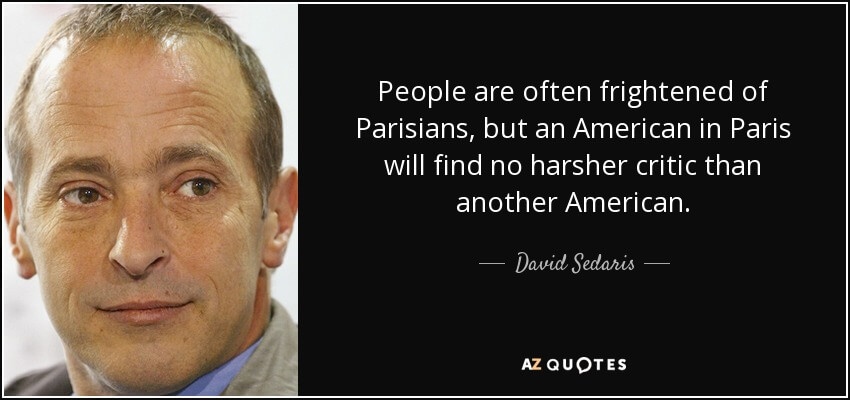
David Sedaris’ opinion that Americans are harsher critics of other Americans in Paris than Parisians are can be extended to a general “foreigner” or other learners bracket pretty much anywhere.
At the start of my Erasmus year in Italy, a fellow international student – an American who’d started learning Italian two weeks prior – burst out laughing when she heard me speaking Italian with a French student, and said “Lucy, your accent is horrible!” The French student jumped to my defence and explained that she too had a strong accent; we were all learning after all.
Whether you’re learning a language to better integrate in your new home abroad, or you’re learning at home, if you encounter other people attempting the same thing, some of them may try to bring you down to raise themselves up. It’s a pretty useful filtering system for working out who not to hang out with!
People have issues
Sometimes you’ll just come across someone who’s an asshole to everyone, foreign or not.
Back when I was working in Belgium, upon addressing a post office worker in English, she told me:
“You should really make an effort to speak in Flemish, don’t you think?”
A fair point… So next time I delivered a speech I’d prepared in the pigeon Flemish I’d been learning over 2 months since I’d arrived. She instantly replied to me in English, and when I tried to maintain the conversation in Flemish, she stopped what she was doing, stared straight at me, and said, irritated, “English or Flemish?!“.
I later asked my Flemish colleagues what her deal was – turns out she’s unspeakably rude to everyone. Not my problem.
To learn more about my Flemish fails, check out my How not to learn a language: 9 lessons from that time I flunked Flemish post.
Society is biased
Mary Ann Sieghart’s book The Authority Gap: Why Women Are Still Taken Less Seriously Than Men, and What We Can Do About It revealed that 26% of black women report hearing others’ surprise at their language skills and other abilities, compared to 11% of white women and 8% of men.
People are regularly surprised to learn I speak multiple languages, on the basis that “you’re British!”
We may not purely perceive undue criticism, we may actually be receiving it. Detaching from this as “not our problem” is hard work, but really, this is a classic example of “it’s not me, it’s you.”
Part 2: it’s me (it’s all of us)
The language gene myth
Perhaps someone or something, somewhere along the way, convinced you that you don’t possess the “language gene.” Spoiler alert: it’s hokum, as I explained in my 3 incredibly common barriers that are making you think you lack the language gene, and how to overcome them post.
Ironically, this “I’m different” thinking is a very seductive “get out of jail free” card. If we conclude that we don’t have it in us to learn a language, guess what? We can stop trying.
The negativity bias
The negativity bias is a cognitive bias, whereby our brains tend to focus more on negative things than positive ones (e.g. thoughts, emotions, social encounters, traumatic events).
This is even true when an abundance of positive evidence is presented to us, which greatly outweighs the negative.

The negativity gremlin is so cunning that it does an excellent job of explaining away foolproof evidence of our abilities, from successful conversations entirely in our target language, to passing an exam, just because someone asked us to repeat our order in the bakery.
We feel shame physically
Learners often find the speaking part of learning language the most stressful, as it opens us up to other people’s judgement.
Part of the reason that slights to our language skills can seem so traumatic is because we often feel shame physically. As a result, we will sometimes react with a stress response.
We may leave the scene as quickly as possible or abandon our learning journey altogether.
Perhaps we freeze our learning at our current level or stick to interactions with other people who speak our native language.

We may even resort to people pleasing by allowing others to dictate the language of our conversations, promoting others’ skills as “better” than ours, or shying away from compliments about our skills.
4 coping mechanisms
So, how do we tackle these overwhelming forces? Here are my suggestions:
Distinguish between helpful critique and hurtful comments
I recently listened to Heidi Lovejoy interview Kris from Deutsch mit Kris, on Heidi’s Love, Joy, and Languages podcast. Kris talks about her journey learning German, and stresses the importance of distinguishing between helpful critique and hurtful comments.
Examples include “actually, it’s pronounced […]; make sure to stress the […]” versus “that’s not how you say it. Your accent is so […].“
If you can sort through these in the moment – and it takes practice – then you can learn to use the helpful critique for good and to discard the hurtful comments completely.
Recognise when you’re having a stress response
If your reaction to someone’s comment leaves you feeling like you want to abandon your learning altogether, guess what, you’re not alone! We’ve all felt that way at some point.
If you can recognise that your desire to abandon ship is a perfectly natural response and isn’t a sign from God that you should give up, you’ll take less notice next time it rears its ugly head.
Make a list of all the times your efforts paid off
This one is a language gratitude journal, of sorts. You’d be surprised how often you get things right; here’s mine from the last two weeks in Germany:
- I successfully managed to explain which items I needed to a shop assistant at OBI (Germany’s answer to B&Q).
- I’ve had a series of conversations with service staff, where they didn’t switch to English!
- I recently listened to an episode of the Easy German podcast in the background, and suddenly realised I had understood the whole conversation for the last 5 minutes.
Take a leaf out of Lady Gaga’s book
I will never get tired of hearing Lady Gaga’s “a hundred people in the room” story, or of watching Bradley Cooper act like it’s the first time he’s heard the skit.
Seriously, though, it helps to have relentless cheerleaders around. Find other people who are as passionate about learning your target language or another target language as you are, and cheer each other on!
Final thoughts
In this piece, I couldn’t recall any examples of horrible things said to me about my Spanish or Portuguese. Perhaps it’s because by my third and fourth language, I made fewer mistakes? Very unlikely; mistakes are an inevitable and important part of learning.
Perhaps I exuded more confidence, meaning that people felt less able to really stick the knife in? It’s possible.
However, I’d say that the two defining factors are 1) surrounding myself with people who are focused on building people up, not pulling them down, 2) the change in my mindset regarding learning foreign languages.
I no longer see errors as proof that I’m not good enough. I’ve stopped taking myself seriously on the matter, will simply ignore people intent on laughing at me, and warm to people who laugh along with me.
Does this post resonate with you? Comment below!
MORE LIKE THIS ›



Something went wrong. Please refresh the page and/or try again.


Leave a comment