

I recently realised in conversation with friends in German, I was perpetually recycling ja, verstehe and genau as reactions to others’ storytelling.
In an attempt to expand my vocabulary, I started listening for what German speakers would say in conversation, and thus this mega-list was born.
I hope this helps you too!
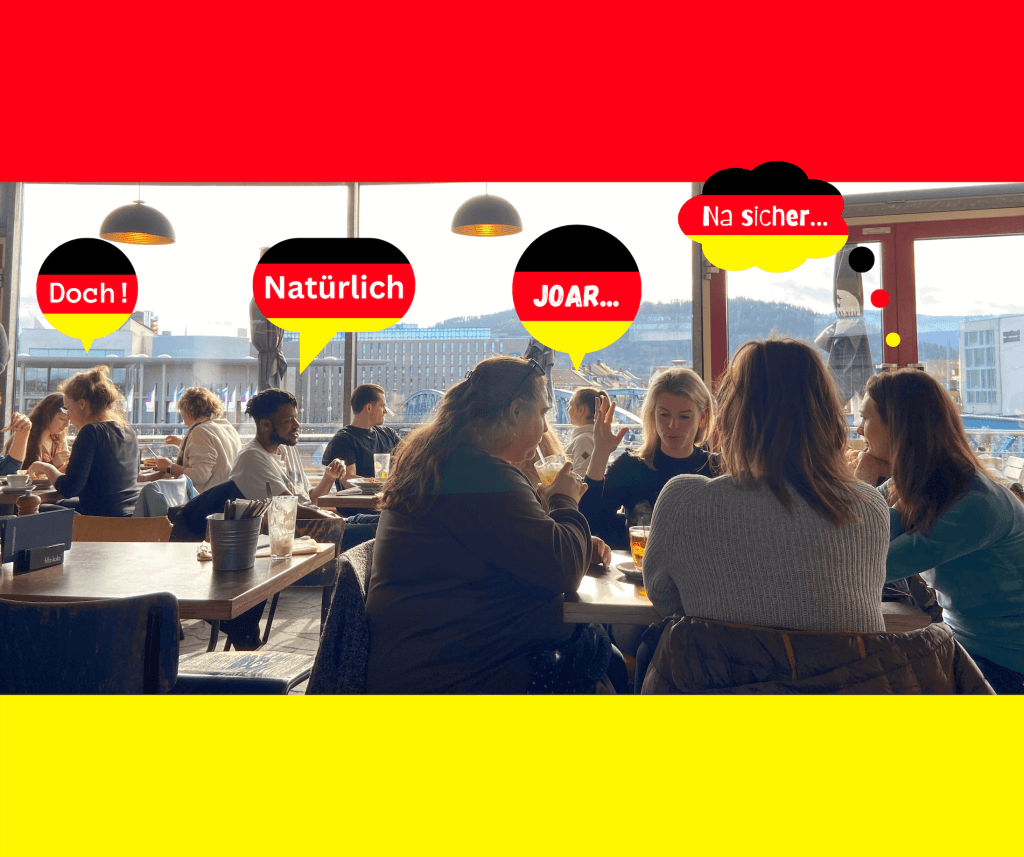
- Alternatives to ja
- Point out the obvious
- Alternatives to nein when invited somewhere or asked for a favour
- Kick the can down the road
- Agree with others
- Challenge others
- The grey area
- Express surprise
- Express understanding
- Alleviate tension
- Downloadable word mat
- Final thoughts
Alternatives to ja
Just as advanced English speakers avoid overusing the word yes, to sound more native in German, it’s worth learning an array of alternatives to ja. Here are some of the most common:
| Auf jeden Fall | Yes indeed |
| Gern(e)* | Gladly |
| Unbedingt | Absolutely |
| Abgemacht | Deal |
| Das klingt gut | Sounds good |
| Das klappt | That works |
| Das passt | That works |
*Gern(e) is also commonly used as an alternative to Bitte (as in, “you’re welcome):
– Danke schön! – Gerne!
Point out the obvious
If you want to sound really German, point out the obvious on the odd occasion.
Bear in mind that this selection, as well as the expressions under “Alternatives to ja” can be polite or sarcastic, depending on tone:
| Na klar | Of course / obviously |
| Na sicher | Of course / sure |
| Natürlich | Of course / naturally |
| Selbstverständlich | Of course / doubtless / obviously / naturally |
Alternatives to nein when invited somewhere or asked for a favour
Germans will generally just say no if they don’t want to do something, but that can be a little alarming if you come from a culture where that’s really impolite.
Here are some alternatives to soften the blow, except for the last one, which is for when someone proposes something ridiculous, like going for a spontan trinken, or paying for your drinks in rounds, rather than getrennt:
| Leider, kann ich nicht | Unfortunately, I can’t |
| Lass es uns etwas anderes versuchen | Let’s try something different |
| Leider bin ich beschäftigt | Unfortunately I’m busy |
| Ich habe keine Zeit | I don’t have time |
| Auf keinen Fall! | No way! |
Kick the can down the road
If you’re not ready to say no to something, it’s worth having some phrases to buy time; here are my favourites:
| Lass mich eine Nacht darüber schlafen | Let me sleep on it |
| Ich schaue mal, wenn ich Zeit habe | I’ll take a look when I have time |
| Ich kann nichts versprechen | I can’t promise anything |
| Lass mich nochmal darüber nachdenken | Let me give it another think |
Agree with others
If you live in Germany, you will hear the word genau constantly; just because the natives overuse it, doesn’t mean learners have to! Here are some alternatives when you want to agree with someone:
| Genau | Exactly |
| Stimmt | Right |
| Bestimmt | Surely / likely / I imagine so |
| Ich stimme völlig zu | I totally agree |
| Du hast recht | You’re right |
| Richtig | Right / correct |
Challenge others
Once you get to know Germans a little better, you will feel more comfortable displaying a bit of resistance. Give these a try:
| Doch! | Yes! [emphatic and in contrast to negative statement just said] |
| Eigentlich… | Actually… |
| Komm schon! | Come on! |
| Ohne scheiß* | No shit! |
| Ne | Nope / nah |
| Kein aber! | No buts! |
| Ich bin dagegen | I disagree |
*This is really rude…
The grey area
The grey area is small in German. The beauty of the German language is its precision, so there are rarely occasions that require such wishy-washy words, but the word jein in particular can get you out of plenty of sticky situations, amongst a couple of others:
| Jein | Yes and no |
| Joar | Ergh, ok, but I’m not remotely convinced |
| Vielleicht / eventuell / möglicherweise | Perhaps |
Express surprise
Everyone likes to know that their storytelling is entertaining, so get expressive with these:
| Echt?! | Really? / For real? |
| Wirklich?! | Really? |
| Ach so! | Oh, I see! |
Express understanding
Get into the German mindset by hearing how Germans tick, and make sure you’ve got some responses for when they tell you how things are going:
| Verstehe | I understand |
| Wie ärgerlich/toll | How annoying/amazing |
| Ohne Zweifel | Without a doubt |
| Es tut mir leid | I’m sorry |
| Alles klar! | All right! |
| Wie schade | What a shame |
Alleviate tension
Germans are notoriously hard to pin down, especially at short notice, due to the packed schedules their heavy planning produces.
As such, it’s likely that a fair number of your invitations are met with leider kann ich nicht. It’s worth having some neutral responses that conceal your frustration at your lack of plans in the early days of living in Germany:
| Keine Sorge | No worries |
| Kein Problem | No problem |
| Alles ok / in Ordnung | All good |
Downloadable word mat
Want to print these for your next German conversation? Download my word mat, which includes even more simple words and phrases to sound more fluent in German!
Final thoughts
The first step to learning these words is listening out for them.
Play conversational bingo as you eavesdrop on the train or at the park, or as you listen to simple German podcasts – you’ll be amazed how often you hear genau, natürlich and gerne, amongst many other words on this list.
Then try these out alone – in your head, out loud in conversation with yourself, and with others!
Are there any other words you use regularly? Are my list and word mat helpful? If so, please like and share this post 😊
MORE LIKE THIS ›



Something went wrong. Please refresh the page and/or try again.


Leave a comment