

So, your German is now at B1 level – first off, congratulations!
Whether you’ve stepped outside your comfort zone to practice speaking, powered through endless grammar drills, or binged German TV in the name of “studying,” you’ve put in the work.
You can hold conversations, express opinions, and get through daily life in German without breaking (too much of) a sweat.
Now it’s time for some fine-tuning. Some of those stock phrases you’ve been relying on might need a little tweak, and a few sneaky mistakes could still be creeping into your German. Let’s take a closer look at some common errors—and how to fix them – so you can take your German to the next level.
Mistakes you’ll never make again
Misusing “Es gibt”
In English, “There is/are” is used quite flexibly, but in German, Es gibt isn’t always the right choice.
| ❌ Es gibt hier viele Leute → ✅ Hier sind viele Leute. ❌ Es gibt Schnee auf der Straße → ✅ Schnee liegt auf der Straße. |
Es gibt is best used in the following cases:
- Existence
- Es gibt keine Zauberei!= Magic doesn’t exist!
- Talking about food
- Was gibt es? Es gibt Nudeln = what are we going to eat? We’ve got pasta.
- Fixed statements
- Was gibt’s es?= What’s up?
- Das gibt’s doch nicht! = That’s not true/impossible!
- Gibt es noch Fragen = are there any more questions?
Using “als” incorrectly
Many learners struggle with als, especially when discussing things in the past. Als is used for comparisons (Peter ist größer als Maria) and past events. Wenn is used for repeated actions or conditional statements.
| ❌ Wenn ich ein Kind war, spielte ich oft draußen. ✅ Als ich ein Kind war, spielte ich oft draußen. ✅ Wenn ich studierte, hörte ich immer Musik. |
Use als when talking about a one-time event in the past, and wenn for something habitual in the past.

If in doubt when it comes to sentences in the past, replace the als/wenn with “every time”, and if it makes sense in English, then use wenn. If it doesn’t, use als:
| Wenn ich studierte, hörte ich immer Musik → Every time I studied, I would always listen to music ✅ Als ich ein Kind war, spielte ich oft draußen → Every time I was a child*, I would often play outside ❌ → When I was a child*, I would often play outside ✅ *Consider childhood as one life stage to think of it as a “one-time event in the past.” |
Mixing up “wenn,” “wann,” and “ob”
All of these can translate to “when” or “if” in different contexts, but they are not interchangeable.
| Wann (when) – used for questions and indirect questions. ✅ Wann ist den Konzert? ✅ Ich weiß nicht, wann das Konzert ist. Wenn (if/when) – used for conditional or repeated events. ✅ Wenn es regnet, nehme ich einen Regenschirm mit: if it rains, I take an umbrella. ✅ Wenn ich nach Deutschland reise, besuche ich meine Freunde: when I travel to Germany, I visit my friends. Ob (whether/if) – used when there’s uncertainty or two options. ❌ Ich weiß nicht, wenn er kommt oder nicht. ✅ Ich weiß nicht, ob er kommt oder nicht. |
Confusing “seit” and “vor”
Seit is used for actions that started in the past and are still ongoing (seit = for + period of time). Vor is used when talking about something that happened a certain time ago (vor = ago).
| ❌ Ich lebe in Deutschland vor drei Jahren. ✅ Ich lebe seit drei Jahren in Deutschland. ✅ Ich bin vor drei Jahren nach Deutschland gezogen. |
Confusing “bevor” and “davor”
Bevor is a subordinating conjunction and is used to introduce a subordinate clause. Davor is an adverb and is used to refer back to something mentioned earlier.
| ❌ Ich gehe ins Bett, davor ich meine Zähne putze. ✅ Ich gehe ins Bett, bevor ich meine Zähne putze. ✅ Ich putze meine Zähne. Davor lese ich ein Buch. |
Overusing “dass” instead of infinitive constructions
German more often uses infinitive constructions over “that” clauses.
| 😐 Ich hoffe, dass ich bald meine Freunde sehen kann (not incorrect but less common). ✅ Ich hoffe, bald meine Freunde zu sehen. |
Mixing up word order after “also”
The word also in German means “thus” or “so” and influences word order depending on its placement.
| If also starts a sentence chunk, the verb comes immediately after it: ✅ Es gefällt mir, also werde ich es kaufen: I like it, so I will buy it. However, if also is used to mean “well,” then the subject + verb order is maintained: ✅ Also, ich werde jetzt gehen: Well, I’m going now. If also is in the middle of a sentence, it follows the normal word order: ✅ Ich habe also keine andere Wahl: so I have no other choice. |
Using “realisieren” instead of “merken” or “erkennen”
Many learners use realisieren as a direct translation of “to realise,” but it actually means “to carry out” or “to make something a reality” in many cases.
| ❌ Ich habe realisiert, dass ich meine Schlüssel vergessen habe. ✅ Ich habe gemerkt, dass ich meine Schlüssel vergessen habe: I realised that I forgot my keys. ✅ Ich habe erkannt, dass er Recht hatte: I came to realise that he was right. ✅ Er realisierte seinen Traum: he realised his dream. |
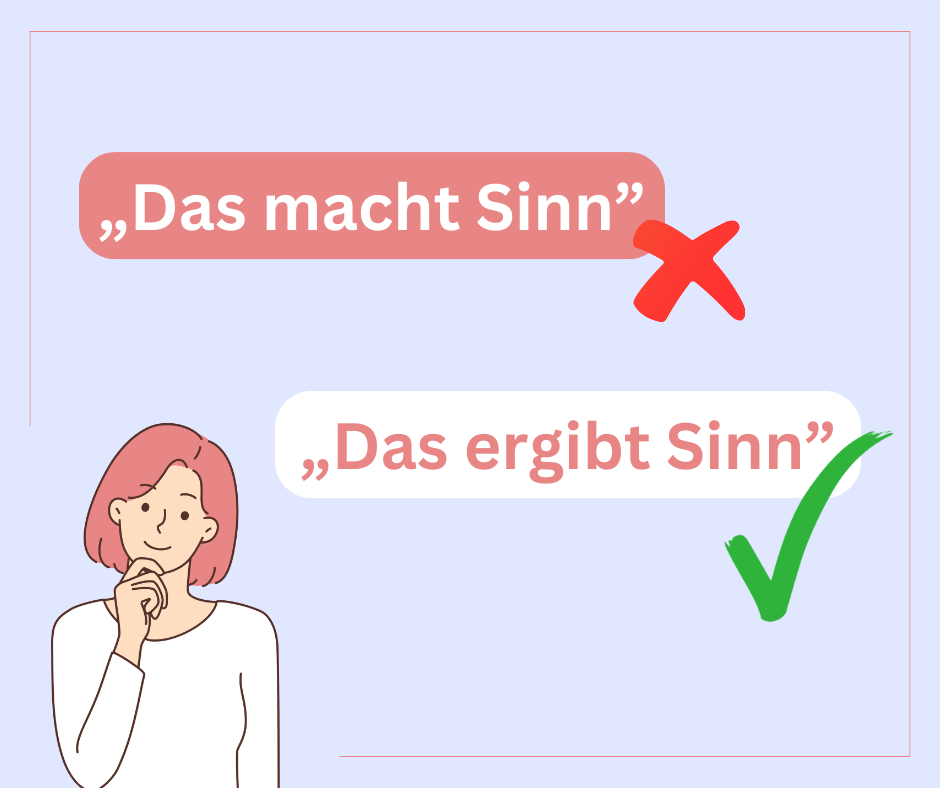
Saying “Das macht Sinn” instead of “Das ergibt/hat Sinn”
You might even hear native speakers say this one:
| ❌ Das macht Sinn. ✅ Das ergibt/hat Sinn. |
While Das macht Sinn is widely understood, it’s not correct. Hat or ergibt (from ergeben, meaning “to result in”) are the proper verb choices here.
Using “eventuell” instead of “schließlich” or “irgendwann”
In English, “eventually” means “at some point in the future,” but the German eventuell actually means “possibly” or “maybe.” Schließlich conveys “finally/in the end” and irgendwann conveys “someday”, or simply “eventually.”
| ✅ Ich werde eventuell nach Hause gehen: I might go home. ✅ Ich werde schließlich nach Hause gehen: I will eventually go home. ✅ Alles endet irgendwann: everything ends eventually. |
Overusing “machen” for every action
In English, we often use “make” or “do” broadly, but in German, different verbs are preferred for different contexts.
| ❌ Ich mache eine Entscheidung. ✅ Ich treffe eine Entscheidung: I make a decision. ❌ Er macht ein Foto. ✅ Er nimmt ein Foto auf: He takes a photo. |
An effective way to move away from machen is to list verbs that go with nouns on your vocabulary lists. For example, instead of writing just der Fehler, write einen Fehler begehen = to make a mistake.
Confusing bekommen and werden
Bekommen means “to get” or receive, whereas werden means “to become.”
| ❌ Ich bekomme Lehrerin. ✅ Ich werde Lehrerin: I’m going to be a teacher. ✅ Ich bekomme ein Geschenk: I get a gift. |
Using “Ich bin interessiert” instead of “Ich interessiere mich für”
In English, we say “I am interested in…” but in German, the construction works differently. We can still use interessiert, but to mean “it interests (me)”:
| ❌ Ich bin interessiert in Kunst. ✅ Ich interessiere mich für Kunst. ✅ Das interessiert mich nicht. |
Learn natural German with accuracy
Netzverb Satzapp has been one of my favourite discoveries for learning German.
If you’re not sure how a word should be used, simply type it in and you’ll find example sentences at all the different CEFR levels.


You can even change the language of the translations, if English is not your first language.
I recommend writing a sentence alongside any vocabulary list, to commit it to memory, whether you copy one from the site, or adapt or create one yourself.
Downloadable PDF
Find below this post in PDF form, with a gap fill activity at the end to check comprehension:
Final thoughts
I have made every single mistake on this list (some more than once). For a number of them, I had no idea what I was saying wasn’t correct, and it was only thanks to kind German speakers who told me “Eigentlich sagt man…“.
If you don’t have German speakers around, Italki is a great alternative; keep a record of recurrent errors you’ve had corrected, and stick it on your wall if you need the reminder!
Enjoyed this list? Used my PDF? Please like and share this post!




Leave a comment