

If you’re learning French, you probably know that arguing about language is a national sport in France.
There’s no obligation to weigh in on the debates surrounding inclusive writing, the feminisation of jobs titles, and more, but it’s worth knowing what all the fuss is about if you really want to understand the French mentality when it comes to language.
So, without further ado, here are 7 surprising things about gender in French:
There’s an institution that regulates language use in France
L’Académie Française is the French council for matters pertaining to the French language. The Académie has a history of proposing some proposing hilarious translations of new English words, rather than having English corrupt the French language. Here are a few gems:
Wi-Fi → “Accès sans fil à internet” (literally “wireless access to the internet”)
pop-up shop → boutique éphémère (“ephemeral boutique” – fancy!)
start-up → jeune pousse (literally “young sprout”)
spoiler → divulgâcher (a mix of divulguer – to reveal, and gâcher – to spoil)
Some of these simply didn’t make it into officialdom after proposal at the Académie, whilst others have been formalised, but are still largely ignored by French speakers.
In Quebec, Canada, however, translations are more readily used, with even big brands like FKC enjoying a francisation, to Poulet Frit Kentucky.
Translation is compulsory under Quebec’s French Language Charter (Bill 101), in place since 1977.

Even words that refer to women are often masculine
The craziest thing I found about the French language is that the word “vagina” is masculine (le vagin)! As are the words “breast” (le sein), “womb” (l’uterus), “hymen” (l’hymen) and even “clitoris” (le clitoris)! The only feminine words in this area are: “vulva”(la vulve) and bust (la poitrine).
The French aren’t the only ones to pull this, of course.
In English, the “Fallopian tubes” are named after an Italian, “the pouch of Douglas” after a Scot (as Hannah Gadsby explains) and Bartholin’s Glands after a Dane. But let’s leave that for another day…
Back to French: many of French’s word genders can be attributed to Latin, meaning that these clunky male misattributions to female parts are shared in other Latin languages. Of all the words I’ve mentioned, only “vagina” is feminine in Portuguese, Spanish and Italian.
“Masculine trumps feminine” – but it hasn’t always
There is a famous phrase about grammar taught to all French school children: Le masculine l’emporte sur le feminin, which means “masculine trumps feminine.”
This refers to the use of the masculine form of an adjective when referring to a group, in which at least one member is male.
This means that just the presence of a male cat amongst a group of women will warrant the use of the masculine form of an adjective: Les femmes et le chat sont fatigués.

This is labelled as sexist by some, and argued as a point of grammatical accuracy by others, on the basis that the masculine serves as neuter, since French only has two genders. One of the members of L’Academie Française has written about this very topic, naming this issue an “ideological battle” imported from the United States.
This structure isn’t an irrefutable fact, however. Historian and linguist Eliane Viennot explains that the rule was invented in the 17th century, and replaced “the rule of proximity”, which previously allowed agreement between an adjective or past participle and the closest noun to that agreeable word.
For example, whereas nowadays, the sentence “Les garçons et les filles étaient heureusEs,” would be considered incorrect (the adjective should be “heureux” due to the presence of “garçons“), prior to the 17th century, it was perfectly acceptable because the word “filles” is closer to “heureux/ses” than “garçons“.
Natives sometimes struggle (and even refuse) to feminise job titles
The feminisation of job titles for a time completely divided the nation.
Until L’Academie Française voted in favour of the feminisation of jobs in 2019, many female politicians continued to request that their male counterparts refer to them as “Madame LA Ministre”, sometimes to no avail.
Whilst some jobs have simply been feminised (chanteur–>chanteuse), others have resisted, like the French word for “firefighter” (sapeur-pompier), with speakers undecided between sapeuse-pompière and femme sapeur-pompier.
The feminine version of a job title isn’t always the best choice in certain contexts as it can sometimes change the meaning of a sentence. For example, if one says elle est l’écrivaine la plus titrée de France, rather than using the masculine form écrivain, then the implication is that she is the most successful female author in France. We’d need to use the masculine écrivain to make clear that she is the most successful writer out of all authors.
There’s no distinction between woman and wife, but there is between man and husband
In French, Portuguese, Spanish and German (amongst other languages no doubt) no distinction is made between a “woman” and a “wife”, for the respective terms femme, mulher, mujer and Frau can mean both.
Interestingly, the Italians do distinguish between donna (woman) and moglie (wife). To use the phrase “my woman” in Italian would be slightly odd, of course, as we’d end up with mia donna, uncomfortably close to the Virgin Mary herself. This is unsurprising, since the name Madonna originates from the Old Italian phrase ma donna, meaning “my lady.”
Inclusive writing has many up in arms
If you really want to start an argument amongst the French, bring up L’écriture inclusive, something created to tackle stereotypes and eradicate sexism in the language. It has three principles:
- Words relating to rank, job or title should agree with the gender of the person they refer to e.g. une charpentière, une autrice, un homme de ménage.
- Universal terms should be neutralised e.g. instead of saying les droits de l’homme (the rights of man) say les droits humains (human rights).
- Throw out the old structures: this has a number of elements:
- When referring to multiple people, alphabetical order should dictate the order of the sentence rather than the traditional “ladies first” structure e.g. rather than saying les mairesses et les maires, you’d say les maires et les mairesses.
- Instead of the principle of le masculin l’importe sur le féminin (masculine trumps feminine), either follow the rule of proximity or prioritise the noun that represents the majority when it comes to adjectives e.g. les décorateurs et les décoratrices sont satisfaites OR les décorateurs et la décoratrice sont satisfaits.
- Condense two genders with a mid-point e.g. les citoyen•ne•s
The third principle has many people up in arms, with L’Academie Française declaring that inclusive writing puts the French language in “deadly peril“!
In particular, there are some heavy critics of the mid-point structure because it makes reading challenging.

Choosing the wrong gender for a noun can cause trouble
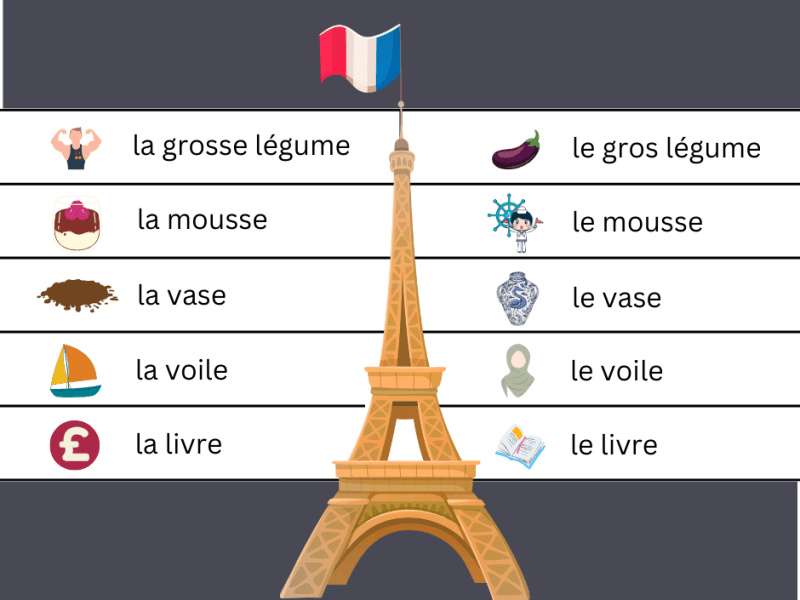
There are many French words that change meaning in the masculine and feminine.
This is unfortunate for French learners, as you can end up making some pretty embarrassing mistakes, like that time I ordered a cabin boy in a restaurant (un mousse), instead of a chocolate mousse (une mousse).
Check out my “I’ll have the cabin boy, please”: 16 French words that change meaning in the masculine and feminine post for more of these.
Final thoughts
Want to know more about these topics? Check out three channels I swear by for improving one’s listening skills:
Watch this video about the Académie Française, from Karambolage, a German-French venture:
Watch this video about inclusive writing from Un jour, une question, where complex questions are answered simply for children:
Watch this video by video media house Brut, on the feminisation of jobs:
For some more resources to learn about French culture, history, current affairs and more, read my 5 brilliant websites for French news and history to improve your listening and reading – beginner to advanced post.
Enjoyed this post? Please like and share it!





Leave a comment