

Having read This Woman Went On 50 Bumble BFF Dates, And Here’s What She Learned About Making Friends As An Adult on Buzzfeed upon my arrival in Germany, I figured I could follow suit, right here in Deutschland, and that I’d be surrounded by new deutsche Freundinnen in no time!
So I got swiping, wrote some seriously pigeon German, and waited for the invites to roll in.
Spoiler alert: I didn’t go on 50 friendship dates. Not even close.
This shouldn’t have surprised me. After all, in German, you don’t “make” friends, you find them (Freunde finden) and let me tell you, the Germans are experts at hide and seek.
But if you’re determined – and learn how the game is played – there are ways in. Here are eight methods I’ve tried, tested, and rated on both friend-making and language-learning potential:
Bumble BFF
Over a few weeks, I messaged many many many women. About a third replied. A few kept the conversation going. Five friend dates were scheduled (after filtering out the women whose availability was only in 3-4 weeks’ time..!). Four cancelled, all last-minute. None rescheduled (rude). It was a particularly cold and dark February, but still.

The one woman I did meet was lovely, and we hit it off. But she was a single parent and hard to pin down, so our budding friendship fizzled out after a few failed attempts to meet again.
That said, I did get something out of it: written German practice. Messaging gave me time to think, look things up, and cement vocabulary. I learnt loads just reading profiles (thank you, Google Lens). Would I rely on Bumble BFF again? Probably not. But it wasn’t a total loss.
Score:
Language exchange events
I went to my first Sprachstammtisch within weeks of arriving – a casual event advertised on Facebook. I turned up at a pub and scanned the room. No signs. No flags.
Recognising someone from the event photo, I approached and asked if this was the language group. He smirked and said, “Nope, don’t know what you’re talking about.” Hilarious.
I was the only woman bar one, who made her excuses after just 20 minutes. As soon as I sat down, one man launched into rapid-fire German and seemed offended that I couldn’t keep up. I ended up chatting in Spanish for the rest of the evening while the other half of the table spoke in English. Hardly the immersive German I was looking for.
Another event landed me in the back of a church with a group of Mormon missionaries playing board games. Nothing against religion, but that information would’ve been useful on the marketing material… It was incredibly structured, where we (no Germans in sight) were organised into a game of 20 Questions. I’d just wanted to chat informally with native-level speakers over a beer. I left after an hour.
Score:
Language classes
Around four months in, my A2 German teacher proposed we go for a drink to celebrate graduating from A2.2, outside the “laboratory setting” of the classroom.
This was the first time I realised I could hold a prolonged conversation in German. I chatted with a Russian classmate, invited her for coffee, and we’ve met regularly ever since. We speak mostly German, occasionally switching to English if we get stuck.
Sometimes, you don’t need a native speaker to practise – just someone who doesn’t mind (or notice) just how slowly you’re talking.
The reason I’ve given this 3 stars is because this only bore friendship-fruit because of the great move by my teacher to get us to a social space. Without this, I never would’ve thought to extend an olive branch to a classmate.
Score:
Live with Germans
If you’re looking to flat-share and can afford to be picky about housing – pick locals. Living with Germans is a goldmine for:
- Understanding bureaucracy
- Tapping into a human dictionary
- Practising your German in low-pressure bursts
It’s not a guarantee, and it can be hard to transition to German full-time if you’ve established the relationship in English, but having native speakers around makes a real difference. Even brief casual chats in the kitchen helped me build confidence.
Score:
Facebook groups and events
A great move I made was joining Facebook groups for newcomers and women in my city. I went to a “girls’ night” and met a mix of locals and other foreigners, all genuinely up for making friends.
From that first event, more invitations followed – brunches, walks, drinks. Unlike Bumble BFF, people actually showed up. And unlike formal language exchanges, these settings made it easier to just talk.

Score:
SWAF: Start With A Friend
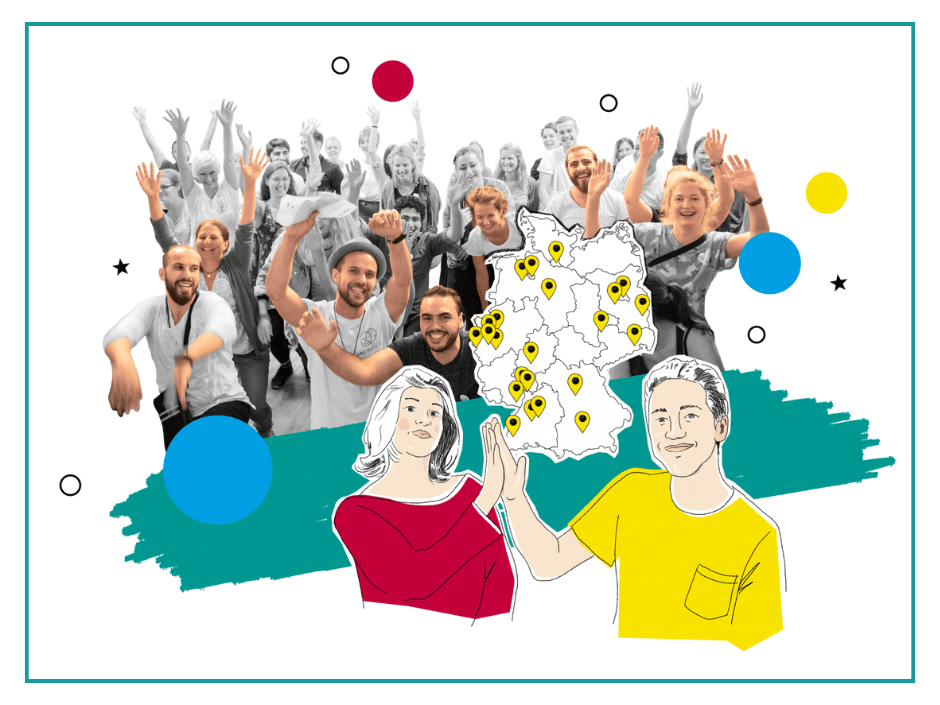
SWAF is such a beautiful thing! Start With A Friend is active in 15 cities across Germany and Austria. SWAF pairs newcomers with locals for friendship and support. Originally designed to help refugees integrate, it now supports any foreigner looking to connect.
The matching process is surprisingly personal – you fill out a form about your personality, age, interests, and goals. I got matched quickly with someone my age, and we’ve hung out regularly ever since.
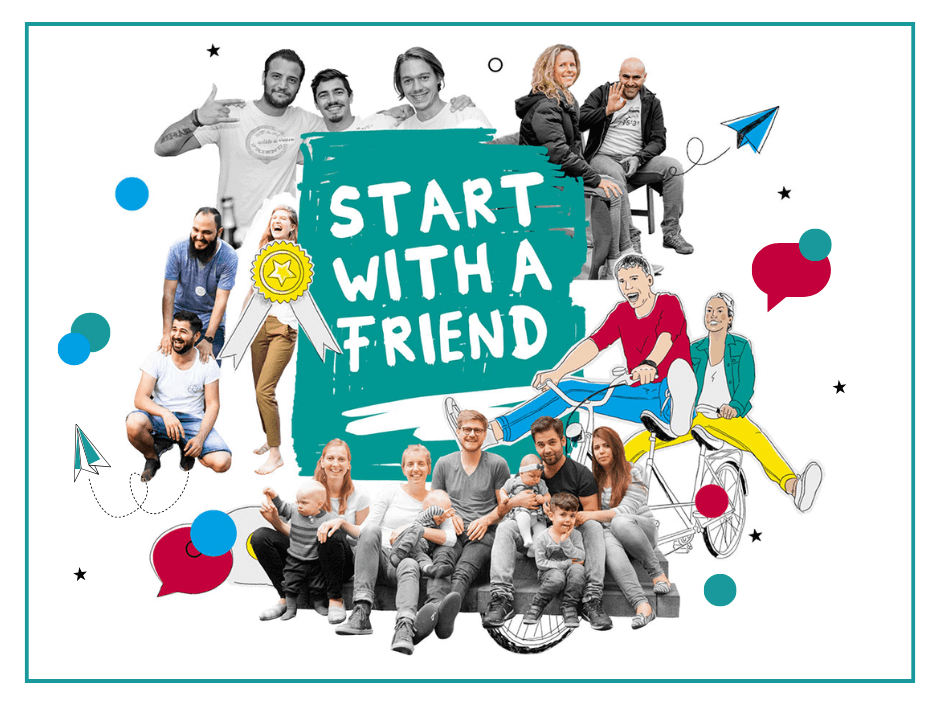
The events are great too: quiz nights, waffle-making, Christmas cookie evenings – all in German. Since a lot of the attendees don’t speak much English, it’s Deutsch or die, which was invaluable practice when I was A2 level.
Score:
Schport machen
If there’s one thing that’ll get you consistent interaction with Germans, it’s Schport.
Germany’s Vereine (clubs) cover everything from hiking and handball to dog-searching societies; just google “Vereine [+ your city].”
If you’re not much of a sport (or dog) person, check out your local Volkshochschule (adult education centre) for courses on pottery, creative writing and more.
I tried a women’s boxing class for a while, but gave up after a time because I found the people unfriendly, and the new trainer refused to play music during training!
I also joined a run club; it took months of having the same conversation with different strangers (great for fine-tuning your intro spiel!) before I made an actual friend, but eventually, it happened. Regularity helps: showing up again and again builds trust – even if no one talks much at first. I’ve since left the club but kept a friend, result!
Score:
Connect with colleagues
If you work in a largely international company where English is the default, like I do, you might have automatically gravitated towards people whose language you have in common. That’s perfectly natural, especially if you spoke no or little German when you started your job.
If there are opportunities to practise my German at work, they haven’t emerged yet! For now, work is my English-speaking safe zone. I like having at least one environment where I’m not constantly decoding cultural cues or trying to guess the gender of a compound noun. For me, that balance has made the harder bits of integration more manageable.
Score:
Final thoughts
The single biggest thing that’s improved my German since moving here is making German-speaking friends. After 18 months here, I’ve made five friends with whom I speak German; even a year ago, I wouldn’t have believed that was possible.
The first six months were frustrating. I’d made friends easily in Spain, Italy, Belgium and France. Germany was shaping up to be a very different kettle of fish.
Here, friendships are earned slowly, and carefully. Many Germans are cautious about blending social circles. “What if they don’t get on?” isn’t just a passing thought – it’s a real barrier.
The upside is that once you’re in – you’re really in. Just remember that it’s all about consistency, curiosity, and accepting that it takes time. In Germany, it pays to be the tortoise, not the hare.
How has your experience making friends in Germany been? Have you tried any other methods?




Leave a comment