

The speaking part of any language exam is often the most nerve-wracking – and the TELC B2 is no exception. You’re not just recalling vocabulary or grammar anymore; you’re communicating in real time, with another person, under exam pressure.
But with the right preparation, the speaking exam doesn’t have to be your worst nightmare!
Here’s what to expect:
- You’ll get 20 minutes of prep time before speaking.
- The exam is done in pairs, with another learner.
- You’ll go through three tasks together, discussing prompts like a natural conversation.
- It starts with a brief self-introduction – don’t worry, this part isn’t graded.
The speaking section is worth 25% of your total score – and you need at least 60% in both the written and oral sections to pass. So yes, speaking matters a lot.
Ready to boost your confidence and sound like a pro?
Let’s get into it.
Scoring
The final score you will receive on your certificate is out of 75. You will be able to see what you scored for each part.
Note that whilst the final result candidates receive suggests that each section is weighted equally, the internal assessment criteria used by the examiners actually weighs the parts differently, with part 1 being less significant than parts 2 and 3.
More info on this in the Mark Scheme section.
| Exam section | Total score |
| Teil 1: über eine Erfahrung sprechen | 25 points |
| Teil 2: Diskussion | 25 points |
| Teil 3: Gemeinsam etwas planen | 25 points |
Teil 1: über eine Erfahrung sprechen
Part 1 is the same in every exam, meaning that you can fully prepare for it. You must talk about a subject in one of the below categories, for 2.5 minutes, and then answer follow-up questions on your presentation, posed by your exam partner:
- A book you’ve read
- A film you’ve seen
- A trip you took
- A musical performance or sporting event you’ve attended
- An important person in your life
- A memorable experience you’d had
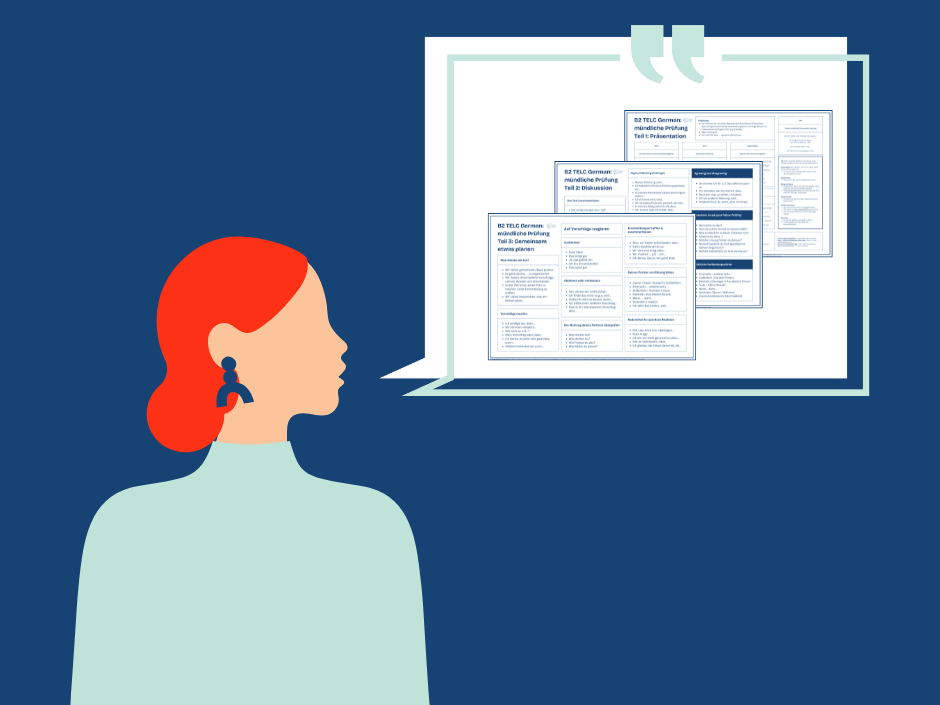
Here’s a help sheet to craft the perfect presentation:
Example presentation
Below you’ll find what I prepared for my exam. I probably didn’t say it word-for-word, of course. I scored 21 out of 25 for it:
| Ich möchte über eine Reise sprechen. Im Mai war ich mit einem Freund nach Istanbul in der Türkei. Wir sind mit dem Flugzeug von Basel aus geflogen. Ich wollte die Stadt schon lange besuchen, weil ich mich für Geschichte interessiere – und Istanbul hat eine sehr reiche Vergangenheit. Was ich faszinierend fand, war, dass die Struktur Istanbuls auf Rom basiert. Zum Beispiel wurden sieben Moscheen auf sieben Hügeln gebaut. Wir haben die bekannteste Moschee besucht, die Hagia Sophia heißt. Heute ist sie eine Moschee, aber ursprünglich war sie eine christliche Kirche. Ein weiteres Highlight war der Große Basar, den ich wunderschön fand. Außerdem haben wir eine Bootsfahrt auf dem Bosporus gemacht – das war wirklich besonders. Meine Lieblingserfahrung war das türkische Frühstück, das Mezze heißt. Es ist eine Kombination aus vielen kleinen Gerichten – süß und salzig gemischt – und ich fand es total lecker. Unsere Unterkunft war eine kleine Wohnung im Zentrum, in der Nähe von vielen lebhaften Bars. Wir hatten auch Glück mit dem Wetter – meistens sonnig, sodass wir viel draußen waren. Ich fand die Leute sehr offen und freundlich. Es scheint, dass sie sich an Touristen gewöhnt haben und sehr tolerant gegenüber anderen Kulturen sind. Insgesamt war es eine tolle Reise, und ich würde Istanbul wirklich jedem empfehlen. |
My top tips:
- Don’t memorise your presentation to the letter: if the examiners think you’re reeling things off, there’s a chance they’ll cut you off, and if you’ve learnt it top to bottom, you may struggle to pick things back up.
- Write your presentation, then record yourself saying it: if your presentation comes to 2.5 minutes, then cut it by at least a third. We speak much more slowly when we’re speaking spontaneously than we do when we’re reading.
- Convert your presentation into bullet points: your bullet points should be note-form prompts to guide your presentation. You should write these bullet points out during the 20-minute preparation time.
Teil 2: Diskussion
Part 2 is the hardest part of the speaking exam in my view. You will need to read a text and then discuss it with your partner, where you each speak for roughly 2.5 minutes.
The texts can be on a whole range of topics, including family, technology, medicine, free time and more. They pretty much always provide two opposing views of the topic.
The objective is the discussion, and not proving you’ve understood every single thing in the text.
The examiner will ask one candidate to summarise (zusammenfassen) the text before you start the discussion.
There are key points you may cover in the exchange:
- Discuss the topic
- Share your experience
- Express your opinion
- Justify your arguments
- Provide possible solutions to the issue
Here’s a help sheet to get you talking:
My top tips:
- Start simply: always start by saying that “The text discusses whether…” = Im Text geht es darum, ob… + topic.
- Learn some phrases to ask for clarification: there’s a chance you’re paired with someone with much lower German, or with a very strong accent that you struggle to understand. See the “Questions to ask your fellow Prüfling” section.
- If you are preparing for the B2 exam independently, get a teacher on Italki to practise Part 2: the key word here is Diskussion, so you need to practise kicking ideas back and forth. If you know someone preparing for the same exam, they’d also work as a sparring partner.
Teil 3: Gemeinsam etwas planen
Part 3 is nice and simple, spanning between 2.5-5 minutes. You either need to solve a problem together, or more often, plan something with your exam partner, usually some kind of outing for a particular group, e.g.:
- Plan a three-day trip for a group of young people in your home town
- Organise a two-day excursion for a group of seniors in a German, Swiss or Austrian city
- Arrange a cultural exchange between students from your country and German students.
Here’s a help sheet to help you get planning:
My top tips:
- Cover who, where, what, why, when: your plans need to be specific. If it’s a three-day thing you have to plan, go through what you’ll do on each day.
- Assign tasks between you and your partner: decide who will call the venue, who will organise the transport or buy the tickets etc.
- Ask your partner what they think of your suggestions, and ask them for theirs: one of the marking criteria requires that participation is “appropriate,” and this is a particularly good section to show this. Show you can take turns naturally, ask for opinions, agree and disagree politely, and build on your partner’s ideas or make compromises.
Mark scheme
The oral examination is assessed based on four key criteria:
a. Expressiveness – how clearly, appropriately, and fluently you express your thoughts.
b. Task completion – how well you understand and respond to the prompts, structure your contributions, and interact with your partner.
c. Formal correctness – the accuracy of your grammar and sentence structure.
d. Pronunciation and intonation – how clearly you speak and how natural your speech sounds.
Each criterion has a maximum number of points and is rated using defined performance levels (A–D). The weighting is slightly different depending on the part – for example, Teil 1 carries fewer points, while Teil 2 and Teil 3 count more heavily, especially for interaction and fluency.

Each of those criteria is assessed based on your performance in Teil 1 and Teile 2 & 3:
| Criterion | Teil 1 | Teile 2 & 3 |
| Expressiveness | Max 4 points | Max 8 points |
| Task Completion | Max 4 points | Max 8 points |
| Formal Correctness | Max 4 points | Max 8 points |
| Pronunciation & Intonation | Max 3 points | Max 6 points |
The examiners assess how you perform on each criterion in Teil 1 versus Teile 2 & 3, then add them up, and somehow they “translate” them so that that each part is then scored out of 25, creating a total score out of 75 points.
This sounds confusing, and frankly it is. Don’t worry too much about the crazy maths behind the mark scheme.
Improve your pronunciation
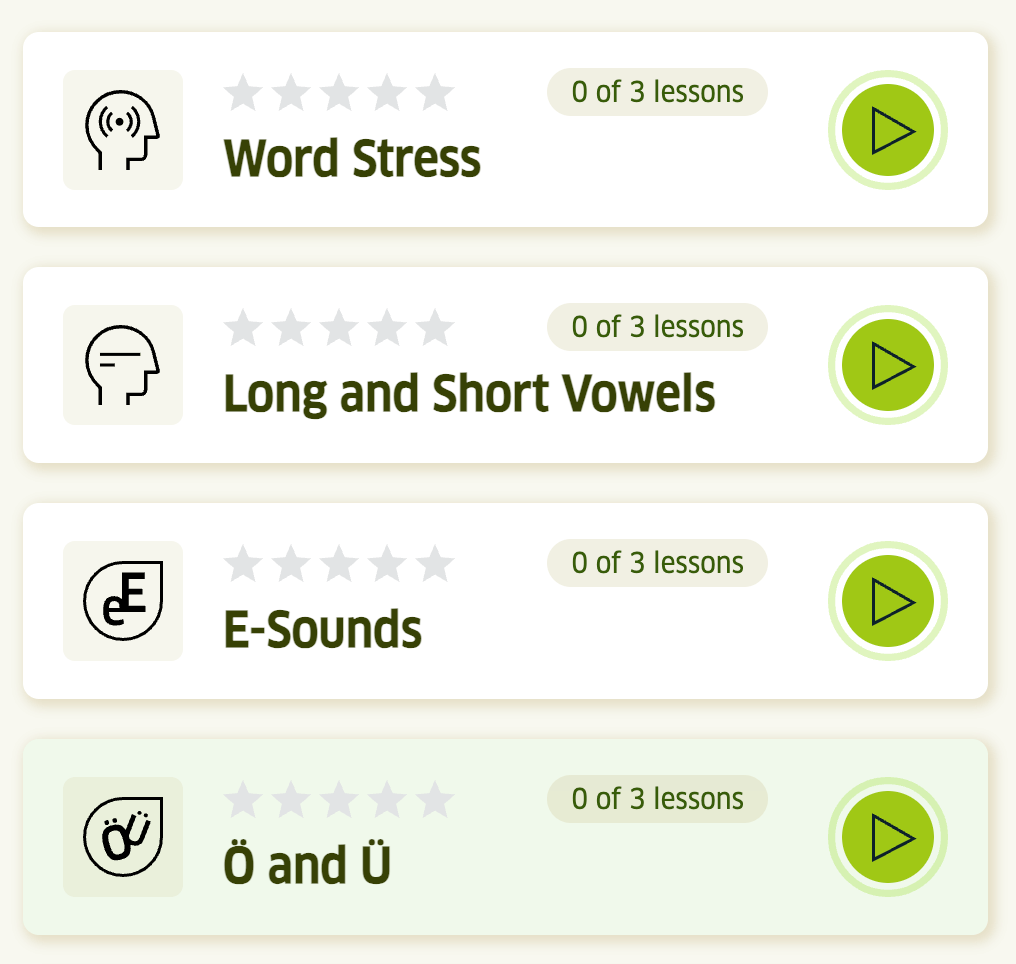
The Goethe Institut Pronunciation Trainer is a comprehensive resource that provides clear explanations of how to make a sound, and exercises to practise them.
It’s available on a browser, not as an app, but you can create an account to keep track of your progress.
You speak into your microphone so that it picks up your pronunciation and assesses its accuracy.
Final thoughts
The B2 speaking exam isn’t about sounding like a native – it’s about showing that you can communicate clearly, naturally, and cooperatively at a B2 level.
When I first looked at the speaking exam format, I had already enrolled in the exam, and panicked. Yet learning the structure of the exam like the back of my hand (partly thanks to preparing this and other posts for my blog), creating cheat sheets and practising the three parts (particularly part 2!) with my teacher weekly, I passed with flying colours, scoring higher in the speaking than in the written section.
Use my three cheat sheets to boost your confidence and fluency. Learn them, practise them, make them yours. And when the exam comes?
Treat it like a real conversation – not a performance.
Has this post helped you? Please like and share it!
MORE LIKE THIS ›


Something went wrong. Please refresh the page and/or try again.


Leave a comment