

If, French pronunciation feels like Everest to you, then you’re in the right place.
I only started to get to grips with it whilst doing an intensive B2-C1 course in Bordeaux a few years ago.
Understanding what French speakers are doing with their lips, tongues and jaws became my obsession.
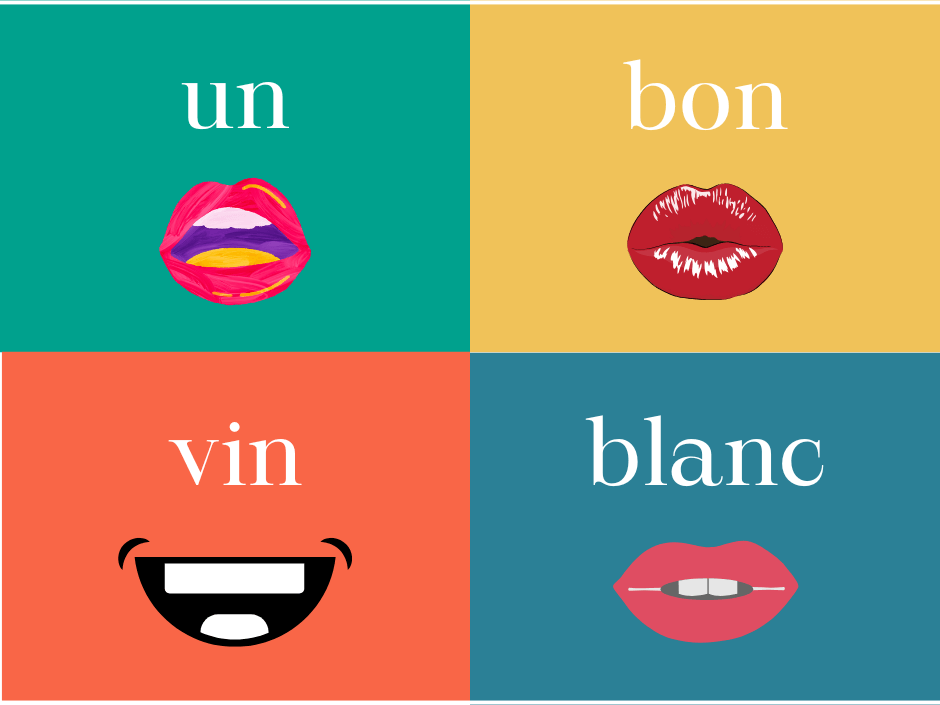
This post is the crux of what I learnt!
If you’re a beginner, check out section one on nasal vowel sounds – which is useful at any level – then come back for the rest when you start learning A2-B1 material.
For the rest of you, there are PDF versions of a lot of the information shared in this post; look out for the white boxes.
- Nasal vowel sounds (A1-A2)
- Differentiating between e, é, è, ê and ë (A2-B1)
- Possessive adjectives with feminine nouns starting with a vowel or muted h (B1)
- Liaisons (B1-B2)
- When to pronounce the final consonant of a word (B2)
- Final thoughts
Nasal vowel sounds (A1-A2)
There are between 3 to 4 nasal sounds in French. Some accents will distinguish 4 vowel sounds in the sentence un bon vin blanc, whereas others will distinguish 3.
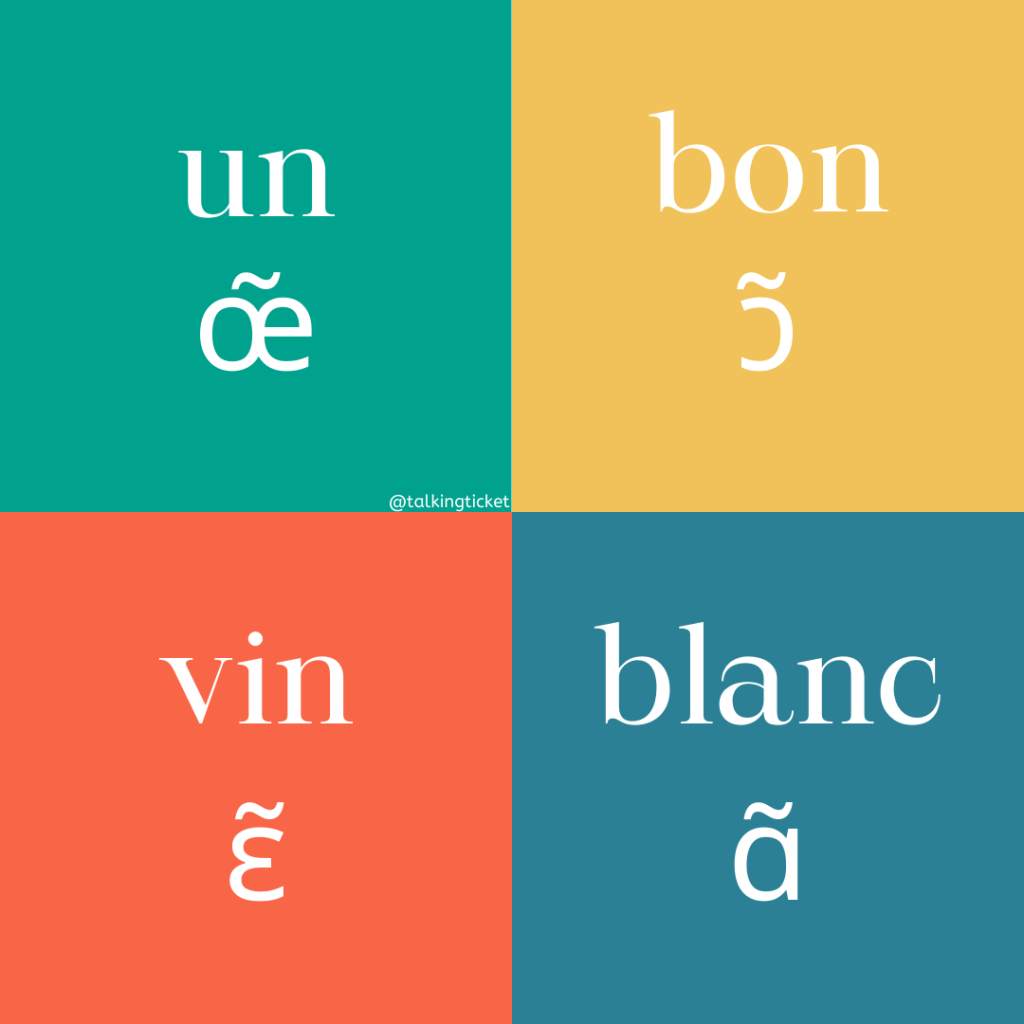
In the South of France, for example, you may hear different vowel sounds in the words un (œ̃) and vin (ɛ̃), whereas in other parts of the country, un (ɛ̃) and vin (ɛ̃) will rhyme when spoken.
When I put un vin into Google translate and clicked on the speaker, for example, I heard two different sounds.
Watch this video on the nasal vowels sounds -on, -en and -ain, produced by Alpha B language school in Nice.
They give an excellent further explanation of the differences, with a great exercise to test your comprehension at the end:
If you’ve now completed the exercise the teacher did at the end of the video above, try pronouncing the sounds in the image below:
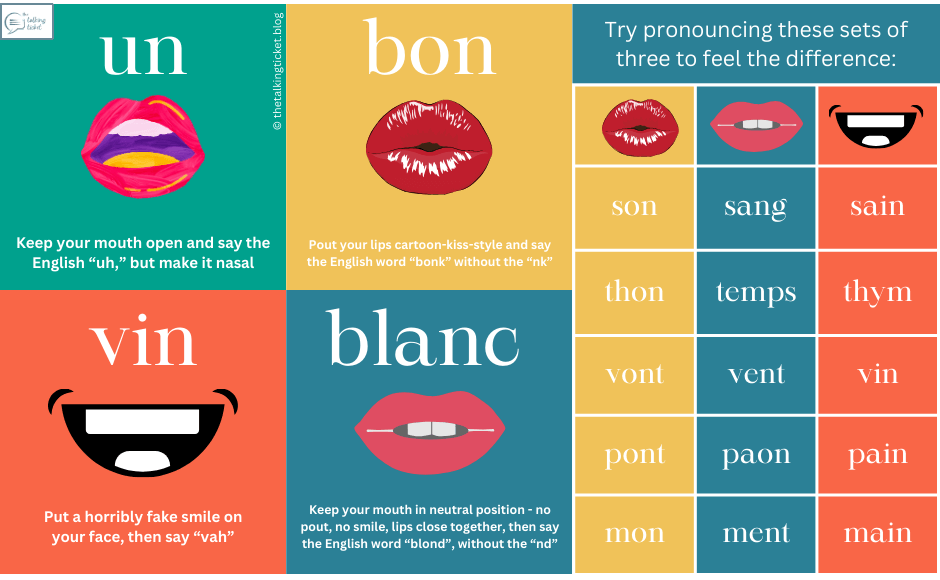
It’s all in the shape of you make with your mouth!
Differentiating between e, é, è, ê and ë (A2-B1)
The beauty of the many French Es is that you only need to learn three sounds:
| Letter | Sound | Example |
| e | Schwa OR silent | je / table |
| é | “ay” (say) | été |
| è / ê / ë (separated) | “eh” (bed) | fête / mère / Noël |
Guillaume Posé gives an excellent explanation on how to pronounce these vowels (note that his explanation is in French, so great listening practice too).
Now try practising yourself with the image below:
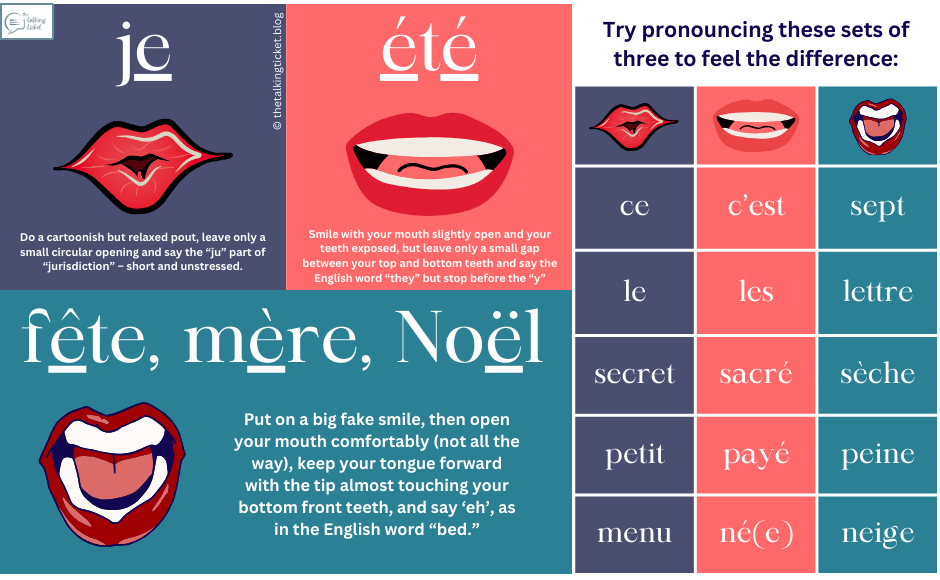
There are exceptions – it’s French, after all. Guillaume goes through some in his video here.
Possessive adjectives with feminine nouns starting with a vowel or muted h (B1)
Over the centuries, guardians of the language have tweaked French to ensure speakers produce only the most beautiful sound sequences.
In the case of possessive adjectives with feminine nouns starting with a vowel or muted h, it’s to avoid a vowel-vowel collision.
We do this in English too, which is why we say “an hour,” not “a hour,” and “an apple,” not “a apple.”
Here are a few examples:
| ✓ mon idée (not ✓ mon école (not ✓ mon horloge (not ✓ mon erreur (not ✓ mon impression (not |
| This also applies to possessive adjectives in other forms: ✓ ton erreur (not ✓ ton habitude (not ✓ son école (not |
| Luckily, since plural possessive adjectives are genderless, this rule does not affect nouns in the plural: ✓ mes amies – “my (female) friends” ✓ tes habitudes – “your habits” |
Liaisons (B1-B2)
A liaison is the pronunciation of a normally silent final consonant when the next word begins with a vowel sound, creating a smooth link between words in spoken French.
There are 3 types of liaisons in French:
- La liaison obligatoire = compulsory liaison
- La liaison facultative = optional liaison
- La liaison interdite = forbidden or “dangerous” liaison
Compulsory liaisons
You must link the words in the following cases:
| Between determiner and noun un, aucun, des, mon, ton, trois, cent… e.g. des‿amis | Between pronoun and verb on, ils, nous, vous, en… e.g. nous‿avons | Between adjective and noun de longues‿études |
| Between verb and inverted subject imperative form: Allons‿y ! questions: Où est‿-il allé ? | After a monosyllabic adverb très, trop, bien, plus, moins… e.g. très‿agréable | After a monosyllabic preposition dans, dès, sans, chez, sous… e.g. dans‿un instant |
| Fixed expressions: tout‿à l’heure, de temps‿en temps, de mieux‿en mieux, c’est‿à dire, Quand‿est-ce que… |
Forbidden liaisons
Do not link the words in the following cases, lest you risk the French thinking you’re a lunatic:
| After singular nouns Un enfant | adorable | After proper nouns Paris | est beau |
| After et un pain au chocolat et | un café | Before words with an aspirated “H” en | haut, les | haricots |
| After a verb in the singular Elle écrit | une lettre | Before onze and oui les | onze personnes |
| After comment, combien and toujours toujours | aimable | After inversion Parlez-vous | espagnol ? |
📄 Download the PDF version (including an exercise to test your knowledge!):
When to pronounce the final consonant of a word (B2)
Roughly 28% of French words end with a silent letter. This includes vowels.
Let’s break down the consonants, which are harder to diagnose as voiced or silent.
Rare final consonants in French
The letters -k, -q and -b are rare at the end of a word; some of the few words that exist with these letters are:
| Voiced b: le club, le snob, le Maghreb. | Silent b: le plomb. |
| Voiced k: l’anorak, le bifteck, le look. | Voiced q: le coq, cinq. |
The other consonants can be split into two categories:
- Final consonants that are mostly voiced
- Final consonants that are mostly silent
1. Final consonants that are mostly voiced
The first category – final consonants that are mostly voiced – can be memorised with a mnemonic: the consonants in the word CaReFuL.
Naturally, there are a number of exceptions, which just need to be learnt.
| Ca | Re | Fu | L | |
| Examples | le parc le choc donc l’arc public le sac grec sec | any noun ending in -eur: acteur, rêveur, or -er: boulanger (pronounced “é”) verbs ending in -ir hiver hier clair | adjectives ending in “f”: créatif, vif, neuf surf juif sauf chef soif | le fil le péril nul avril util |
| Exceptions | le porc le tabac l’accroc blanc l’estomac le banc | verbs ending in -er masculine adjectives ending in “r”: léger, étranger, premier, dernier, entier | le cerf la clef le nerf les oeuf | l’outil gentil |
📄 Download the PDF version:
💡Quick tip on words ending in -c!
- If the -c is silent in the masculine form, then the feminine ends in -che: blanc→blanche.
- If the -c in the masculine form is voiced, then the feminine becomes -que: un lieu public→une maison publique.
- ATTENTION: there are exceptions, where a voiced -c becomes -che in the feminine: sec (voiced)→sèche.
2. Final consonants that are mostly silent
Words ending in d, g, p, s, t, x and z are more often silent.
However, because it’s French, there are plenty of exceptions in each category; here are some examples:
| Examples | Exceptions | |
| D | chaud le canard grand gourmand | le sud |
| G | le coing le bourg le sang long le poing le rang | words ending in “ing”: le camping, le jogging, l’iceberg |
| P | beaucoup trop le champ le coup le drap le loup le sirop | le top le stop le rap |
| S | gris le pois le temps trois vous/nous/ils “s” verb ending: je vis, tu finis | le fils le bus l’ours |
| T | le chat le bout le secret inquiet concret minuit le poulet | le but net l’est l’ouest huit brut |
| X | le voix deux le prix heureux noun and adjective plurals: les châteaux, nouveaux, les journaux | l’intox le vortex le lynx six and dix – except before a noun beginning with a consonant: dix minutes |
| Z | verbs in the second person plural: copiez, parlez, allez chez assez le riz le nez | le gaz |
📄 Download the PDF version:
Final thoughts
If you’ve managed to get to the end of this post, congrats, that was a lot of information!
No one is expecting you to memorise all of this. The first step to mastering any feature of a language is noticing; as long as you are aware of these many rules and more exceptions, then you’re on your way.
So check out my 8 top podcasts with free transcripts for A1-B2 French learners post and start noticing.
With time, you will simply “feel” when something’s right.

Liked this post? Please like and share it!





Leave a comment