

In English, you can clench your fists, jaw and butt. In German, it’s a little more complicated:
- Die Faust ballen = to clench one’s fist
- die Zähne zusammenbeißen = to clench one’s jaw
- den Po zusammen kneifen = to clench one’s butt
This irritating feature doesn’t stop at clenching…
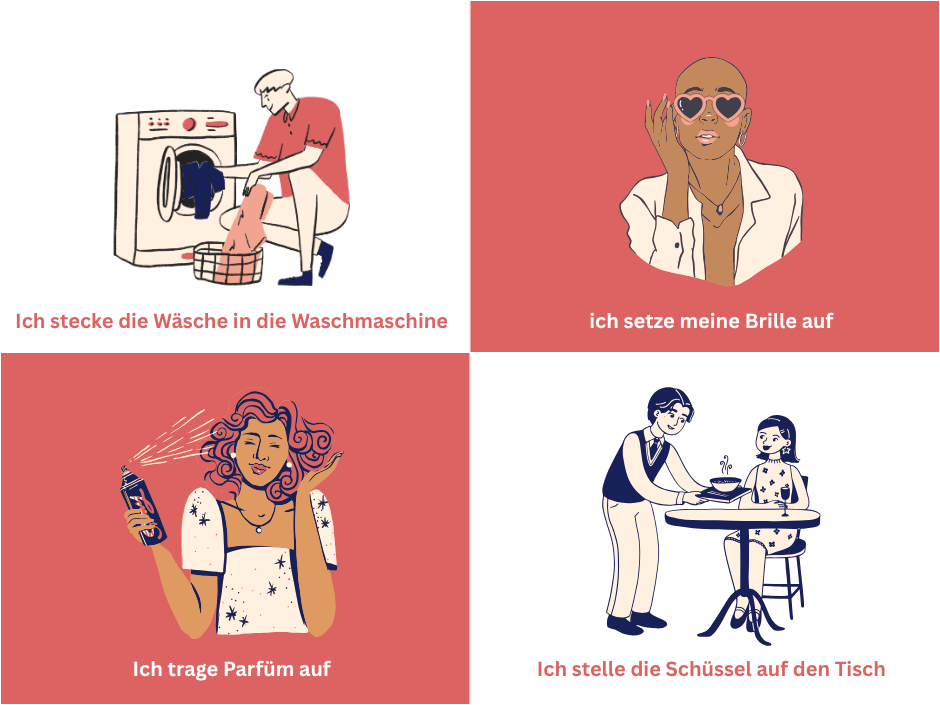
Sadly, catch-all verbs are far more common in English than they are in German. Something that still trips me up, even having passed the B2 TELC exam (read my Everything you need to know about the B2 TELC German exam post for more), is the word “put” in German.
In German, even the way you put something down elicits a different verb. If you put a bottle on the table, use stellen (as it’s stood up), if you put a book on the table, use legen (as it’s laid down). How irritating!
It gets more complicated than that if you want to put something on your face (make-up, suncream), put something away, out, into words, and more!
Here’s my simple list of “put” verbs for everyday German:
A1 level: physical actions meaning “put”
1. Put on clothes/shoes
Anziehen
Zieh deinen Mantel an = put your coat on
Ich ziehe meine Kleider an = I put my clothes on
Zieh deine Schuhe an = put your shoes on
Used for all types of clothing.
Antonym: ausziehen = to take off
2. Put (something upright on a surface)
Stellen
Ich stelle die Flasche auf den Tisch = I put the bottle on the table
Stell die Lampe auf den Nachttisch = Put the lamp on the bedside table
Stellen is similar to the English word “stand” e.g. to stand the ladder against the house. It is used for any object that stands up right, as opposed to be placed lying down on a surface.
3. Put (something lying down on a surface)
Legen
Ich lege das Buch auf das Bett = Put the book on the bed
Leg das Kissen auf das Sofa = Put the cushion on the sofa
Ich lege mich auf das Bett = I lie down on the bed (literally: put myself on)
Legen is similar to the English word “lay” e.g. to lay a cloth on the table.
Sich legen (to lay oneself down) can be replaced by the verb liegen if you’re describing your position, as opposed to movement. It means to lie:
ich liege auf dem Bett (from the verb liegen) = I lie on the bed
Antonym: aufheben = to pick up (as in to lift up/grasp)
A2 level: physical actions meaning “put”
4. Put (accessories like hats or glasses) on
Aufsetzen
Setz deinen Hut auf = Put your hat on
Ich setze meine Brille auf = I put my glasses on
Used for headwear, glasses, etc.
Antonym: abnehmen = to take off
5. Put something into something (bag, fridge, pan/pot etc.)
Tun / stecken / legen / stellen / geben
- Tu die Milch in den Kühlschrank = Put the milk in the fridge
- Steck die Schlüssel in die Tasche = Put the keys in the bag
- Leg den Ball in den Schrank = Put the ball in the cupboard
- Stell die Schuhe in den Kleiderschrank = Put the shoes in the wardrobe
- Gib zwei Löffel Zucker in die Tasse = put two spoonfuls of sugar in the mug*
*If you want to specifically say “add” when talking about cooking, use hinzufügen or hinzugeben:
- Füge eine Zwiebel hinzu = add one onion
- Gib den Knoblauch hinzu = add the garlic
Choose based on shape & context: stecken = insert, legen = lay, stellen = stand upright, tun = fine for informal spoken German, but in writing, more formal contexts and for specific instructions or narration, use stecken, legen or stellen.
Antonym: herausnehmen / entfernen = take something out / remove
6. Put something away / back
Wegräumen / zurücklegen / einräumen
Räum deine Sachen weg = Put your things away
Leg das Buch zurück ins Regal = Put the book back on the shelfRäum den Küchenschrank ein = Put the dishes away
Used for tidying or returning something to its original place.
Antonym: nehmen = take something out
B1 level: everyday use and expressive verbs meaning “put”
7. Put on makeup
Sich schminken
Sie hat sich geschminkt = She put on makeup
A reflexive verb for applying makeup.
Antonym: abnehmen / entfernen = to remove
8. Put on sunscreen or cream
Eincremen / Sich mit Sonnencreme einreiben / Sonnencreme auftragen
Crem dich ein! = Put some sunscreen on
Sie hat Sonnencreme aufgetragen = She put sun cream on
Also reflexive; means “to cream yourself in.”
Antonym: abnehmen / entfernen = to remove
9. Put it over there (temporary placement)
Hinlegen / hinstellen
Leg es da hin = Just put it there (lay it down)
Stell es da hin = Just put it there (stand it up)
“Hin-” adds direction: putting to a place.
Antonym: wegnehmen = to take away / aufheben = to pick up
B2–C1 level: idiomatic and abstract “put”
10. Put something in your diary (to enter or record)
Eintragen
Ich habe den Termin in den Kalender eingetragen = I put the appointment in the diary
Common, neutral, and used in both personal and work contexts.
Antonym: Etwas aus dem Terminkalender streichen = to remove something from one’s diary
11. Put pressure on someone
Unter Druck setzen
Setz mich nicht unter Druck! = Don’t put pressure on me
A fixed phrase, useful in conversation and writing.
Antonym: Druck abnehmen = take the pressure off
12. Put something out (fire, cigarette)
Ausmachen / löschen
Mach die Zigarette aus = Put out the cigarette
Lösch das Feuer = Put out the fire
Antonyms: Ausmachen = to turn off; löschen = to extinguish (can also mean to delete/erase/cancel)
13. Put something into words
In Worte fassen
Ich kann meine Gefühle nicht in Worte fassen = I can’t put my feelings into words
Used to express abstract ideas like emotions, thoughts, or impressions. Common in writing, speeches, or deep conversations.
Final thoughts
If you take anything away from this post, it’s that German truly is the language of precision.
When it comes to refining the details with the correct verbs, as learners it often helps to really think about what we’re doing e.g. when we clench our teeth, we bite them together, hence zusammenbeißen, or when we take something off the diary, we strike it off, hence streichen.
All of this stays pretty theoretical and abstract until we start hearing and using these words ourselves. Check out my podcast posts to get used to hearing precise German, and try incorporating these into your German writing – read my 7 ways to greatly improve your German writing skills (A1-B2) post for help.
Did you find this post helpful? If so, please like and share this post 😊






Leave a comment