

Charlemagne famously said that “to have another language is to possess a second soul”. This is just a fancy and philosophical way of saying that learning a foreign language gives us another personality, another way of looking at the world or another way of being. This “second self” is what Cicero coined as the “alter ego” in the 1st Century AD, Latin for “other I”.
I love living out my foreign alter egos; they make my language skills better and my life more interesting.
If you’re not convinced this is worth a try, consider Villanelle in Killing Eve; minus all the killing, she looked like she was having a great time in her foreign alter egos.

Villanelle changes many aspects of her appearance, behaviour and manner of speaking to suit the character she creates for each of the languages she speaks.
Scientists are still arguing about whether this kind of thing points toward a whole separate personality in bilingual and multilingual people, or is simply a social code-switch. We can all code-switch even in our native language(s) and culture(s): the phenomenon of adjusting our behaviours, way of speaking and even appearance in different social settings. For example, most of us speak to grandma differently than we do our friends.
Does this mean we have multiple personalities? Probably not, but it shows that we’re all capable of developing alter egos in our target language(s).
Why develop an alter ego?
Creating an alter ego in your target language has many benefits. For one, it can be an opportunity to reinvent oneself outside of what we been taught is “acceptable” behaviour in our native culture.
If these behaviours or traits suit us well, we can even import them back into our native language. A study conducted by Harvard Business Review found that people who live abroad are regularly presented with things contrary to what they’ve always believed to be immutable truths, meaning that they become accustomed to either discarding or strengthening their own values according to their preferences. This can equally apply to the language-learning process, where you are exposed to different ways of thinking and speaking.
An example of this is the fight against the British “stiff upper lip”, or the fact that when we Brits ask “how are you?”, we don’t necessarily want to know the details, and when we answer “yeh, good, thanks”, we don’t necessarily mean it.

These niceties are absent from a lot of other cultures; if you ask a Polish person how they are, they’ll tell you honestly and may give you a detailed rundown as to why. Learning a language or about a culture that values self-expression may positively impact your emotional intelligence by giving you permission to express yourself more.
Another benefit of developing an alter ego is that it can make you seem more native, as fluency isn’t just about mastering the mechanics of the language, but it’s also about being able to assimilate visually, whether through the way you walk, dress, your tone of voice and more.
My favourite benefit of having a foreign alter ego is that it’s really fun. It’s an adult’s version of having a dressing up box or participating in the school pantomime when you’re a kid.
The How-to
Often new learners of foreign languages feel like they’re void of personality, as writer Fatima Malik expressed. This simply isn’t true.
I have distinct memories of many strong characters from my time attempting to learn Flemish whilst living in Ghent some years ago, despite the fact that we were all in an A1 class together and very few of my classmates could speak English. I laughed with Spaniards, Afghans, Brazilians and Poles whilst communicating in pigeon-Flemish.
So how do you inject personality – your native self or an alter ego, into your target language? Here are 6 tips:
1) Determine why you want an alter ego
What do you want to achieve from creating an alter ego? Do you want to shed your English shyness so that you can actually feel confident enough to practise your speaking with others?
Do you want to stop being identified as an anglophone when abroad, like Mitchell when he visits Paris in Modern Family?

Maybe you are enamoured of a particular culture and just want to feel cool and foreign… And why wouldn’t you?
2) Figure out your alter ego’s personality
This can seem overwhelming so I recommend three possible methods for this, to ensure your alter ego fits with a culture of your target language, making you seem more native:
Make friends with a native
When I moved to Italy for my ERASMUS year, I found an apartment where I shared with a Polish woman and an Italian. I spent so much time with the Italian and learnt so much from her, that about 6 months into the year, when I bumped into the guy who had shown me the room (and who was friends with my Italian flatmate), he started laughing, and said “You speak just like Nicole!” He was referring not only to my turns of phrase but also my gestures and mannerisms. Copy, copy, copy.
Observe a fictional character
If you don’t know any native speakers, you can easily get the same experience from your favourite series.
I love the Spanish series Valeria, and really like the character Lola (though less so her mullet…), played by Silma López. I model my Spanish alter ego on her!

Research the philosophy and values of your target language’s culture
This is a huge one that lots of language learners underestimate. You can do this the traditional way, by researching schools of thought. The School of Life has some great videos on philosophers and literature, where you can learn about key French and other European thinkers, which should give you a snapshot into how the French, and other nationalities think.
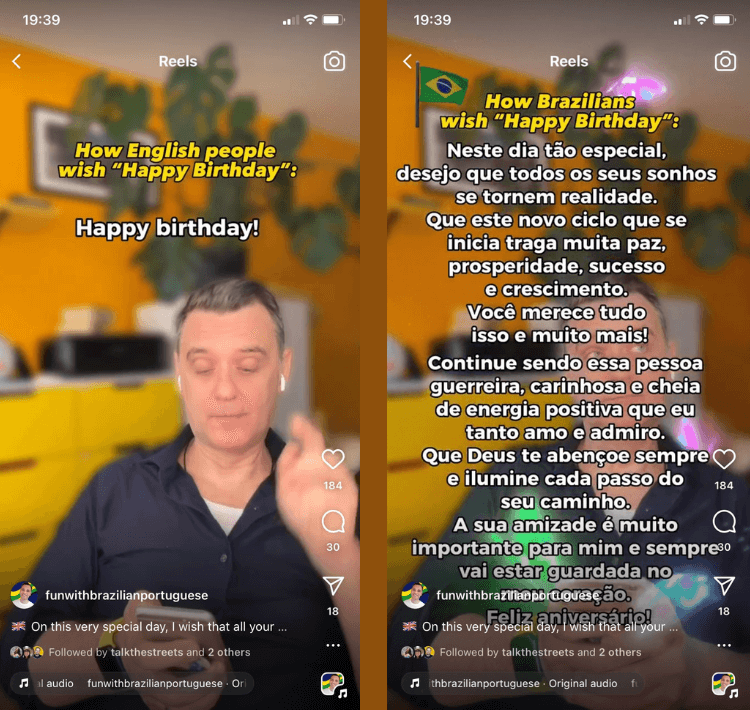
Social media is also an amazing place for learning about cultural traits. For example, check out the difference between how anglophones and Brazilians say ‘Happy Birthday’, from Fun With Brazilian Portuguese:
3) Create a distinctive image
Clothing, mannerisms, a way of walking, a tone of voice, are all worth a thousand words!

Did you know:
- You will sound more French if you simply lower your voice.
- You will sound more Brazilian if you vary your intonation significantly every few sentences
- You’ll seem really foreign to Italians if you don’t use your hands when talking
- You won’t look Parisian if you wear lots of make-up in Paris!
Observe what the natives look like and follow suit. And look carefully, beyond the stereotypes, to avoid this:
4) Pick a name
This sounds crazy but people do this all the time, whether because foreigners can’t pronounce their name (usually anglophones..!), or to reinvent themselves. I’m Lúcia (PT), Lucía (ES) and Lucia (IT). In French, I’m Lucie, which sounds so much cooler than Lucy!
This is a solid method not only to get you into character, but also to get native speakers to see you as more like them. Here’s an example.
5) Adopt a mantra or a call to action
A call to action can help you invoke your alter ego when they’re needed; and if it can go with a pair of sparkly shoes, all the better.

Whenever I’m preparing to speak in one of my foreign languages, I’ll repeat particular phrases to get me in the zone.
6) Act like they would act: “Be water, my friend”
Yes, I did just invoke Bruce Lee. It’s relevant, I promise! I recently listened to Shannon Lee – daughter of Bruce Lee – discussing her Dad’s philosophy and specifically, his most famous quote:
As Bruce says, “you put water in a cup, it becomes the cup.” Become your alter ego whilst speaking your target language! Put together all of these elements of your foreign self and live them. Don’t forget to have fun doing it!
A Persian proverb tells us that “A new language is a new life”. Is this something you can relate to? Do you have an alter ego in your target language? Comment below!
یک زبان جدید یک زندگی جدید است.
Psst! If you liked this post, please give it a like below 😊👇!


Leave a reply to Aude – Fearless French Cancel reply