

The accent aigu (é) and accent grave (è) have distinct sounds, which also differ from the regular French e.
é has a similar sound to the vowel sound in the English word “say,” whereas è has a similar sound to the vowel sound in the English word “bed.”
For more info on this, check out this video by Prêt à Parler CH for a great explanation of the difference.
The circumflex ê is pronounced the same as è, whereas the other circumflex vowels are pronounced the same way as their non-circumflex counterparts.
Learning how to write accents correctly in French will improve your pronunciation and reading ability.
Syllables
Before we dive into how to correct identify which letter to use out of é, è and e, it’s important to know how to split words into syllables in French. Each language has its own rules on this.
- One consonant between two vowels —> a new syllable: anytime you have a word with a consonant between two vowels, the consonant is the start of a new syllable. E.g. a-vi-on, é-lé-phant
- Two consonants between two vowels —> the first consonant is the end of one syllable, and the second one is the beginning of the next: whenever a word has two consonants in between two vowels, you will “break” the word in between the consonants. E.g. dan-ser, fac-teur
- If a word has two of the same consonant together, the first one is the end of one syllable, and the second one is the beginning of the next. E.g. bal-le, ap-pel
- If the first consonant is followed by an r or an l, then don’t separate them: qua-tre, é-cri-tu-re
If you’d like to check whether you’ve correctly split a word into syllables, use silabas.net.
When to write é (accent aigu)
Your first step when learning where to write é is to divide your words into syllables (see above).
Once you’ve done that, find all instances where a syllable ends in a vowel (in this case, e). In such cases, add é. Simple as that! Make sure to keep reading as there is an exception to this!
Check out this really helpful video made by Patricia Douissard, where she breaks down each step in really simple French (as she clearly makes her videos for primary age French children!).
Just note that, as it’s French, there are some exceptions, including pre-mier and re-tour-ner, where even though the first syllable in each instances end in an e, the e is not accented with the accent aigu. It’s another case of having to learn the exceptions, which becomes easier when you already know how the word sounds. both premier and retourner audibly feature the French e, not é.
When to write e
Generally speaking, if you know a word features the French e sound, then you know to use no accent. However, when an e is followed by two consonants, then the vowel is pronounced é, despite being written as e. Examples include des-crip-tion, ex-pli-quer. This is important to ensure you correctly pronounce that é sound!
Naturally, there are exceptions to this, including: ré-créa-tion and é-chec.
When to write è
You need to know how a word is pronounced in order to correctly place the accent grave (è). Once you’ve split your words into syllables, you need to be able to identify any silent es (known as the e muet in French).
The presence of a silent e in the syllable following an e-ending syllable will automatically turn the previous e into è.
E.g. e-le-ve → the last e is silent, meaning that the e before it becomes è → e-lè-ve → the first e follows the accent aigu rule (syllables ending in e become aigu) → é-lè-ve.
Watch Patricia Douissard’s second video on accents for more examples of this!
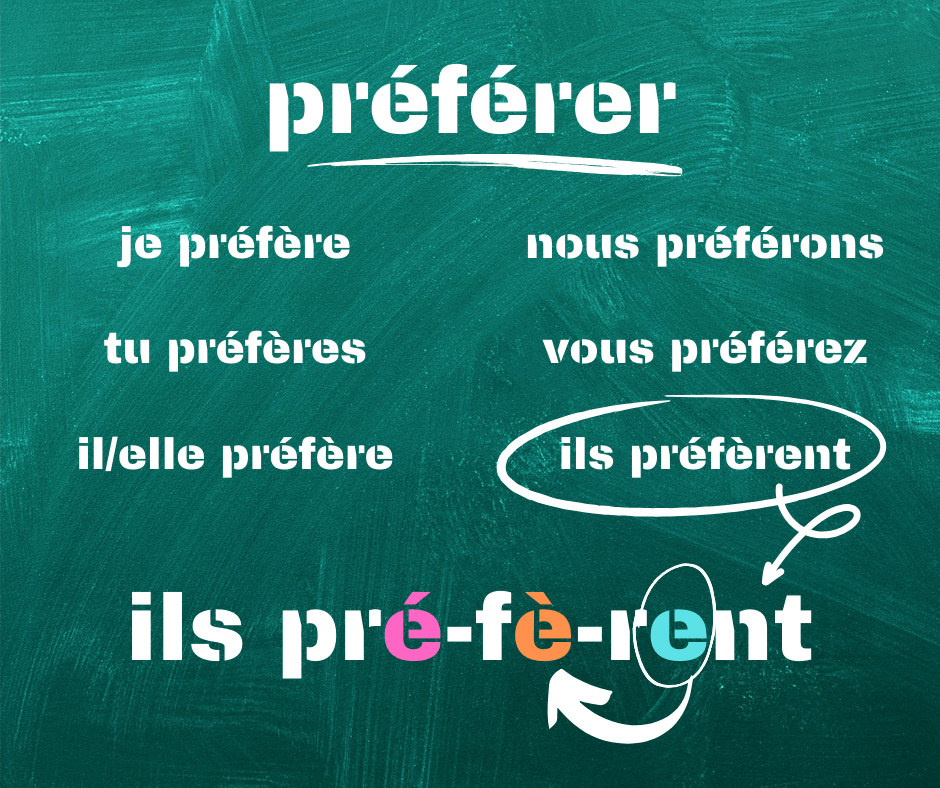
This particular feature explains the verb préférer in the present tense, which can seem like total chaos to get right in writing when you’re just starting out in French.
Once you’ve mastered the rules on e, é and è, you’ll be able to correctly write all forms of préférer correctly.
When to write ô, ê, îl and â
The circumflex usually replaces a disappeared “s,” but in a few instances it may replace another consonant, or a double vowel. In the case of the word âge, for example, it was originally written as aage.
The circumflex is something you’ll come to memorise, and in the instances where you have a doubt about whether to use it – or more often, on which letter to use it, thinking – where would the “s” have been? – will help you with this. For example, for a time I struggled to remember whether it was fôret or forêt. With the “s” rule, I never make this mistake now.
| châtiment ← punishment (think of the word “chastise”) | châtaigne ← chestnut | |
| château ← castle | forêt ← forest | |
| pâte ← pasta | hôpital ← hospital | |
| tâche ← task | île ← island |
Note
The “s” rule doesn’t apply to û; instead, the presence or absence of a circumflex changes the meaning of a word and it’s just something you’ll need to memorise:
| une acre | acre | âcre | acrid | |
| jeune | young | le jeûne | fast (diet, religion) | |
| du | some | dû | past participle of devoir | |
| sur | on | sûr | sure | |
| un mur | wall | mûr | ripe (masculine) |
Test yourself
If you want to test yourself, check out the text below; I’ve removed all circumflex accents, all é and è. Screenshot it on your phone and slice the words into syllables. then follow the steps you’ve learnt above.
Dans le village de Dorville, à chaque fois que nait un enfant, on plante un arbre dans son jardin. Ainsi, en meme temps que l’enfant grandit, grandit l’arbre qui l’accompagne. Par la fenetre de sa chambre, Sam ne cesse de regarder le sien. Car, à mesure que les annees passent, il se rend compte que quelque chose ne va pas.
Dans les jardins d’à cote, les arbres se transforment au fil des saisons. L’hiver, ils courbent leurs branches sous la neige. Au printemps, les bourgeons poussent. L’ete, de petites fleurs blanches percent au milieu de belles feuilles vertes et, en automne, ils font tomber avec grace des feuilles jaunes sur l’herbe des jardins. Mais pas le sien. Celui de Sam reste sec et rabougri, son tronc fragile ressemble à un morceau de bois plante dans la terre. Qu’y a-t-il Sam ? fait soudain une voix derriere lui. Tu pleures ?
Bien sur, à Dorville, ses copains se moquent de lui : « Hé Sam, tu devrais lui coller des feuilles en tissu sur les branches ! » Ou encore : « A l’automne prochain, je te donnerai des feuilles mortes. Tu n’auras qu’à les poser au pied de ton bout de bois ! » Seule Laura, sa petite voisine, lui dit : « Ne t’inquiete pas Sam, un jour il fleurira. »
Un nouveau printemps approche. Sam a tout essaye. Il a arrose son arbre avec des engrais divers, il lui a parle, lui a chante des chansons, mais en vain. Une immense tristesse l’envahit. Il s’assoit au pied de son arbre et sent ses yeux le piquer. « Qu’y a-t-il, Sam ? fait soudain une voix derriere lui. Tu pleures ? » Incapable de repondre, Sam libere de grosses larmes qui roulent sur ses joues et tombent au sol. Laura – car c’est elle – s’approche alors et demande : « Je peux pleurer avec toi ? » Et pendant une heure, leurs larmes se melangent à la terre.
Le lendemain, Sam est reveille par des cris. « Vous avez vu ? » « Mais qu’est-ce qui s’est passe ? » Encore en pyjama, il se precipite dans son jardin et decouvre à la place de son morceau de bois, un arbre magnifique aux brnches gonflees de bourgeons prets à eclater. Laura se tient parmi tous les copains admiratifs. Il la rejoint. « Je te remercie, tes larmes sont magiques ! » dit-il. Elle hausse les epaules et repond : « Il fallait juste qu’on soit deux pour le reveiller. » Et tous les deux, main dans la main, admirent l’arbre en souriant.
Check what you’ve done against the correct version of this short story from Enfant magazine.
If you’ve found this useful, please like and share it!



Leave a comment