

Early attempts at writing in German can feel like flying a multi-stringed kite in a monsoon. Before your pen even hits the page, you’re juggling word order, case, adjectival agreement, compound nouns, and that pesky noun capitalisation.
Writing in a foreign language is often the most neglected skill – because unlike speaking, you can’t bluff your way through it. The page exposes everything: your grammar gaps, half-learned rules, and shaky grasp of case.

What’s more, in the past, we needed a good-natured fluent speaker to correct our work. Thankfully, times have changed and now technology can be your teacher!
Still, it’s tempting to let writing slide in favour of reading, speaking, or listening. But here’s the thing: writing sharpens your grammar, expands your active vocabulary and helps you process the language more deeply. It doesn’t just stay on the page – better writing leads to clearer, more confident speaking, and smoother reading too.
So if you’ve been avoiding German writing practice, here are six smart, doable ways to get better – fast:
1) Read, read, read
It seems counter-intuitive that reading can make you a better writer, but it’s true.
First off, reading will improve your grammar and vocabulary.
Secondly if you’re someone who remembers things visually – that is, you picture words in your head – then reading will also improve your spelling and accents.
This is because, rather than learning a series of rules, you’ll start to simply recognise what a word should look like.
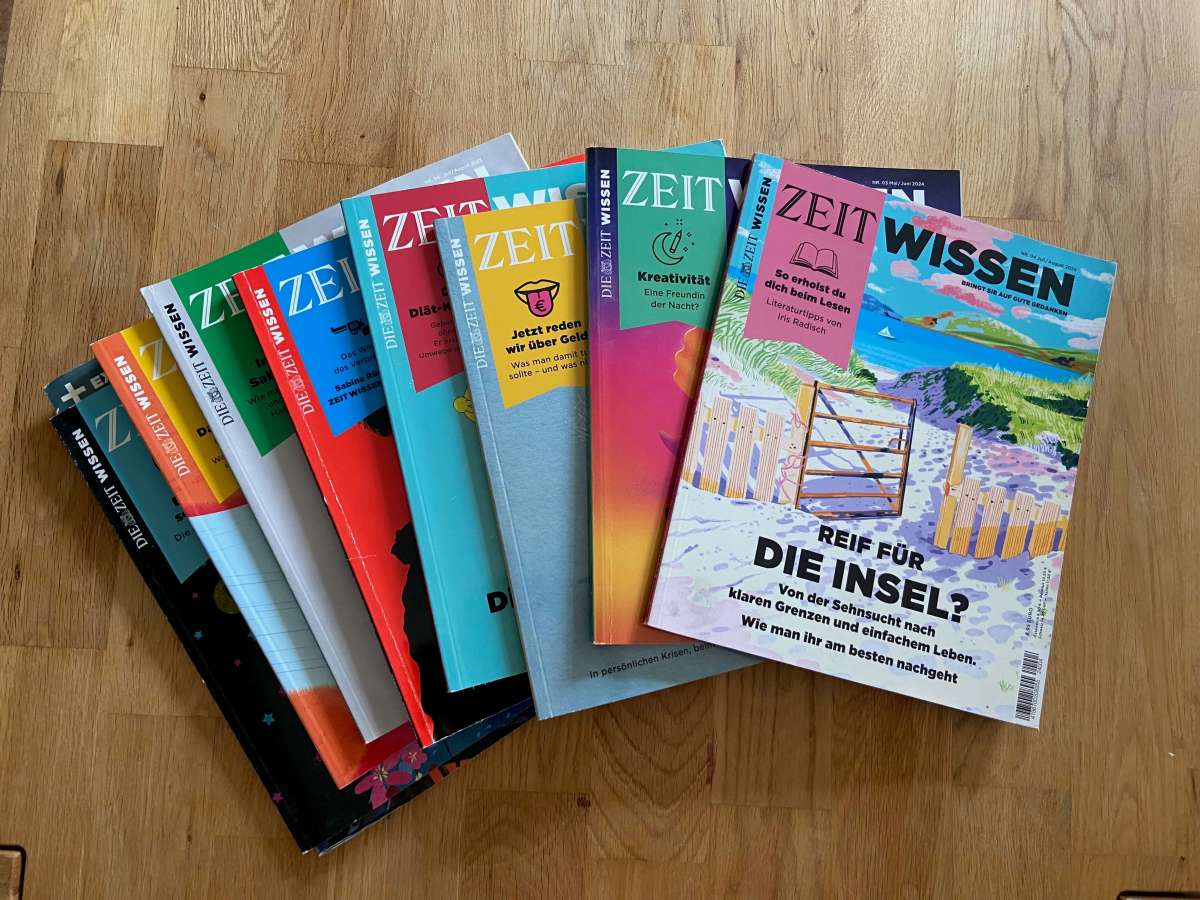
Check out my 10 resources for improving your German reading skills (A1-B2) post for my reading recommendations.
2) Start with someone else’s words: dictation
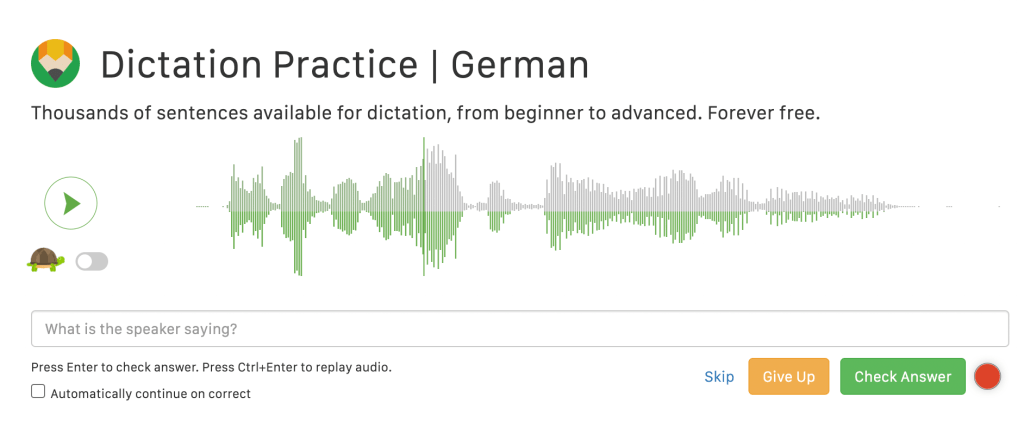
If part of your reluctance with writing comes from not knowing what to write about, then try someone else’s words by completing dictation activities. Listen to a clip, and write down what you hear.
Speechling allows you to choose your level and select a male or female voice. With Speechling you hear brief clips and can check your writing immediately.
For longer form dictation, with more support, check out Lingua.com, where a longer text is spoken, with each sentence said first at a normal speed, then at a much slower pace.
3) Get socialising
Have real-life conversations over messages auf Deutsch!
Texting people really takes the pressure off thanks to autocorrect (the easiest way to learn correct spelling) and it gives you time to clarify doubts before pressing send.
If you live in a German-speaking country, use Bumble BFF to make some pen pals; if you don’t, use Hello Talk.
This method is also one of my favourite mini-missions, which you can read about in my 15 mini-missions to start to learn German in Germany (even if you’ve been living here for years without it) post.

4) Find something to write about
If you’d like to improve your writing for work purposes, I’d suggest using a book like Schreiben für Profis: telc Deutsch Beruf A2-C1, Aufgaben zum Schreiben.
If you’re learning German as a hobby, then there are myriad writing tasks you can set yourself once you feel confident enough to write “free hand”, and they don’t have to be boring!
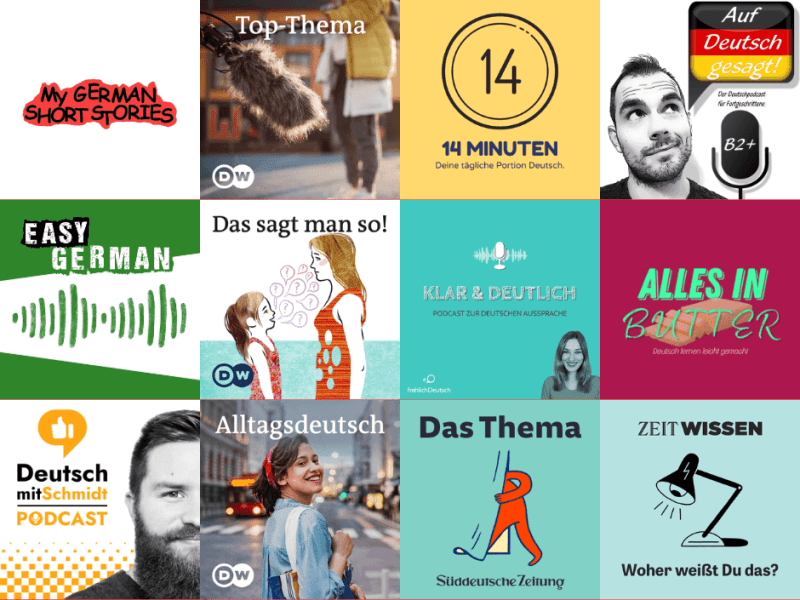
Write summaries of series episodes you’ve watched, podcast episodes you’ve listened to, book chapters you’ve read, or even try writing about your day.


5) Hone your summarising process
Staring at a blank page can be daunting. So build some steps in:
Consume your medium start to finish first
Consume your podcast episode, TV series or book chapter once without making notes, all the way through. This will give you the gist, without bogging you down.
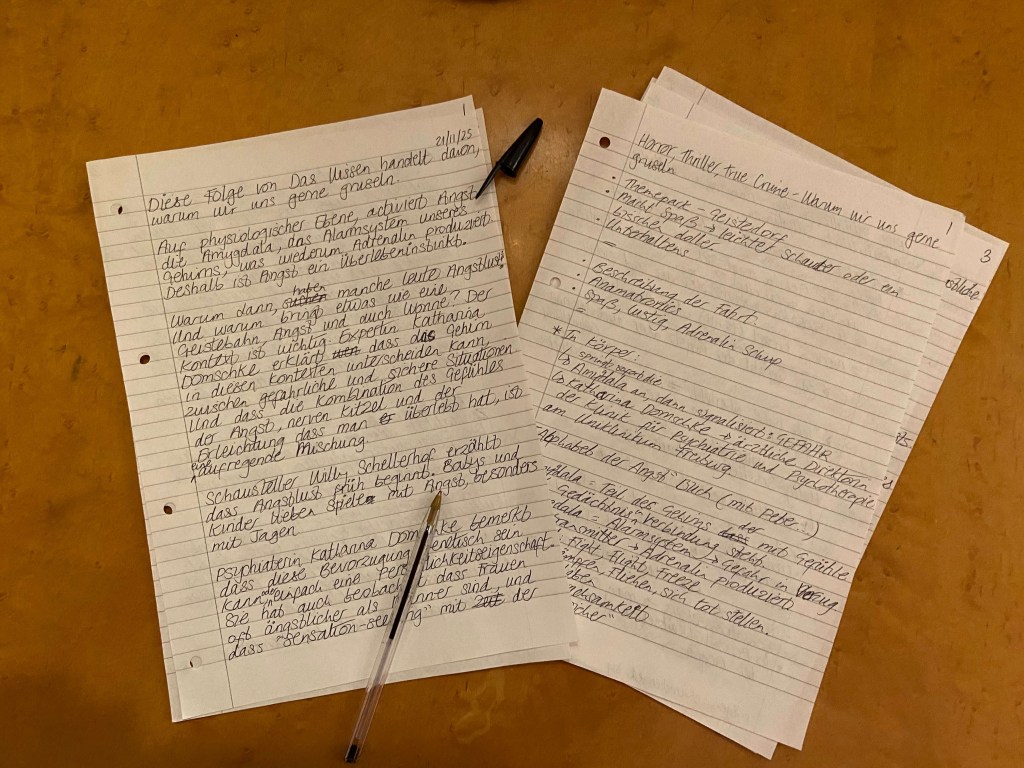
Make notes (by hand!) on the second go
Listen/watch/read a second time, this time making notes – by hand. Why by hand? Firstly, writing by hand boosts memory and learning more than typing does.
Secondly, we can’t write as fast as we can type, which forces us to paraphrase, condense and draw to get the information down. That’s half the summarising battle won already.
Write your summary from your notes
Put the original source aside. Write your summary whilst consulting your notes, and all of the other toolkits I list in number 6 on this list!
6) Ace your writing techniques like a school kid
When you prepared for an exam at school, your teacher (hopefully) got you to approach writing tasks with a check list to ensure you produced something of high quality. Here’s your check list for writing in German:
Use plenty of connectives:
Check out my Make your German flow with these 90 essential connectives for A1 to C1 learners post.
If you’re not sure how one is used, see it in action on satzapp.de: enter a word in the search bar and see example sentences at different difficulty levels.
Print the level-appropriate PDF, or make it your desktop background, and use it whenever you do a writing task.

Use idioms, metaphors and hyperboles:
Impress native speakers by jazzing up your German. Wordreference.com is great for finding useful expressions.
Type in an expression you like in English, and it’ll deliver you the equivalent in German.
For idioms, check out my 28+ useful German idioms for B1-B2 learners (and 5 resources to master them) post.

Use synonyms:
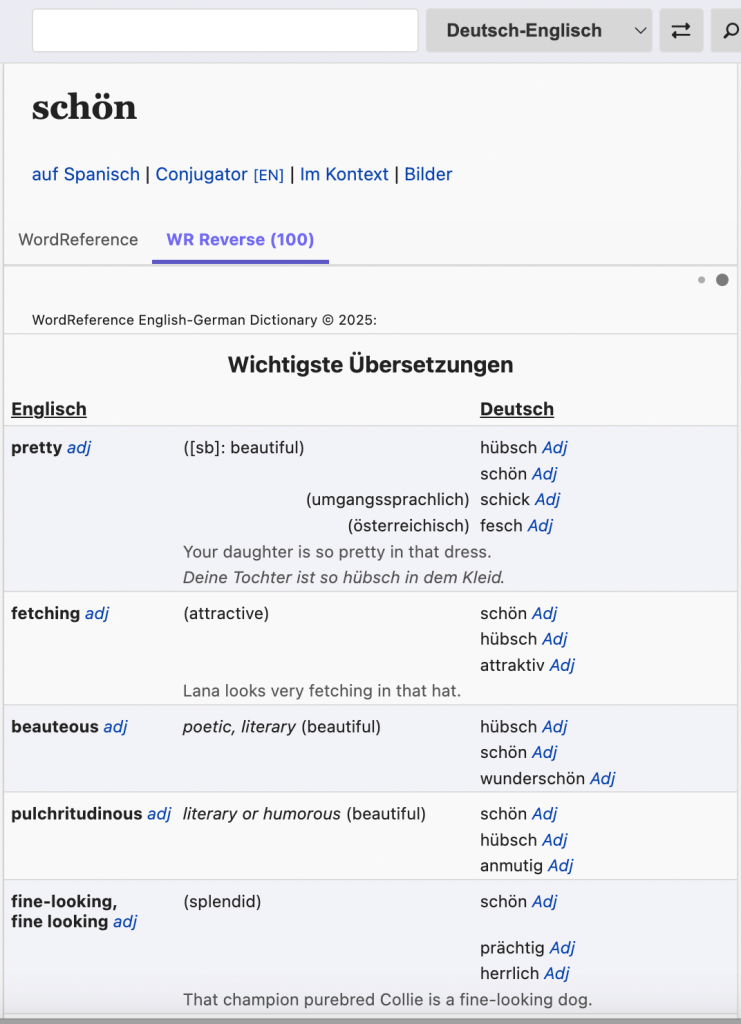
It’s worth building banks of synonyms in a little notebook that you can refer back to.
How many other ways can you say schön?
Use the WR reverse tab for this.
Master umlauts and ß:
Umlauts appear in many German words, for multiple reasons. Here are the most common:
| Pluralised nouns: · Ofen → Öfen · Apfel → Äpfel · Mutter → Mütter | Verbs in the conditional: · haben → hätte · sein → wäre · werden → würde + infinitive |
| Conjugated verbs in the 2nd and 3rd person: · gefallen → es gefällt · laufen → du läufst · stoßen → er stößt · fahren → du fährst · schlafen → er schläft · waschen → er wäscht · tragen→ du trägst · braten→ er brät | Inherent umlauts in base forms: VERBS: · können · mögen · dürfen NOUNS: Tüte Bär Körper |
| Comparative adjectives: · alt → älter · groß → größer · kurz → kürzer | Miscellaneous: · schon // schön |
The Eszett or the scharfes S (ß) is happily much simpler than umlauts. The Swiss have replaced the ß with ss altogether. So in Switzerland, Fuss is used instead of the German and Austrian Fuß.
Need some practice? Try out the exercises below:
| Umlauts: e versus ä and äu ü versus y äu versus eu ö versus ü ä, ö or ü? | Scharfes S (ß) ß versus ss (easy) ß versus ss (medium) ß versus ss (hard) |
Remember that the best way to improve your use of umlauts and the scharfes S is to read. That way you can forget the rules and just know if something looks right.
Pay attention to grammar:
Remember that multi-stringed kite you wrestle with any time you try to build a German sentence on the page?
Give yourself a cheat sheet to steady the wind.
Use one of my phone backgrounds from my 7 essential phone backgrounds to use as the best learning resource for A1-A2 German learners post as an immediate aid any time you write in German.

6) Get your work corrected
There are two ways I recommend you get your work corrected, if you don’t have a fluent speaker to hand:
a) Lang Correct
On Lang Correct you can submit short pieces of writing, and have natives correct your work for free. Here’s an example of a short corrected piece in German.
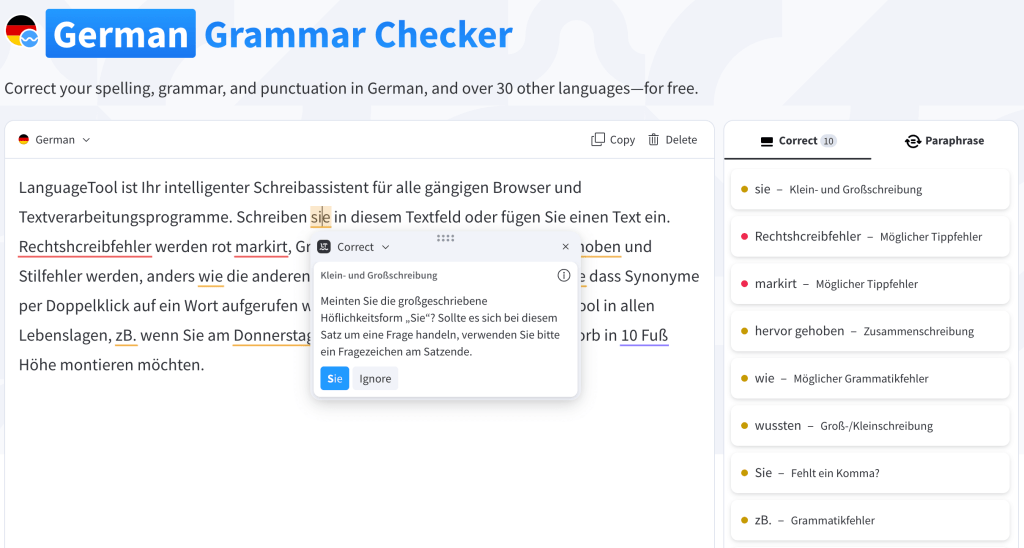
b) Language Tool
Language Tool is useful for when you’re ready to self-correct. Simply type directly into the window, or paste your text into it. The programme then displays your errors and categorises them (red for spelling errors, yellow for other errors).
Learning to spot your own errors and correct them yourself is a key part of perfecting your writing.
7) Make it a regular habit
Write a paragraph once a week, and check and correct it on Lang Correct or Language Tool to ensure good progress.
Don’t forget to keep your summaries so that you can see how much you’ve improved over time; it’s a really motivating feeling when you realise that you can now write a chunky 7-line paragraph full of impressive words and grammar, when a few weeks ago, you were struggling to spit out 3 lines.
Final thoughts
Even if you’re learning German just as a hobby, and writing isn’t high on your list of priorities, hear me out: it’s much less painful to build up your reading, writing, listening, and speaking skills together than to let one lag far behind.
You might feel like a conversational wizard when speaking – fluent, confident, in the zone – but if writing a simple WhatsApp message leaves you second-guessing every word or frantically googling noun genders and adjective endings… well, you’re not alone. This is common for learners who build their language skills informally. This doesn’t mean you have to stay there.
Improving your writing helps reinforce grammar, vocabulary and clarity of thought – which in turn boosts your overall fluency. So even if you don’t love writing now, a little consistent effort goes a long way. Your future self will thank you.
Have you tried any of these techniques before? Comment below!


Leave a comment