

This post is about the general B1 exam by TELC.
The certificate demonstrates your knowledge of the basics of German reading, writing, listening and speaking and your ability to communicate in everyday situations, both personal and professional.
This exam is enough for permanent residency and citizenship applications.

Here’s everything you need to know about the general B1 TELC exam:
- Topics
- Scoring
- Explanation of the 5 parts
- Final thoughts
Topics
Topics that may be covered in the B1 exam include:
Personal information and people
Life stages
Living
Shopping
Education
Free time and culture
Travel and transport
Health
Environment
Jobs and career
Work life
Authorities and institutions
If you need to level up your vocabulary, try Deutsch intensive Wortschatz B1.
Scoring
The exam has five sections, which are scored equally:
| Speaking (Mündliche Prüfung) | 75 |
| Reading (Leseverstehen) | 75 |
| Grammar (Sprachbausteine) | 30 |
| Listening (Hörverstehen) | 75 |
| Writing (Schriftliche Ausdruck) | 45 |
| Total | 300 |
To pass the TELC B1 German exam, you must achieve a sufficient score in both the written and oral sections.
The scoring is divided as follows:
- Written exam (includes reading, listening, grammar, and writing): 225 points total
- Oral exam (speaking): 75 points total
To pass, you must score at least 60% in each section:
- 135 points out of 225 in the written exam
- 45 points out of 75 in the oral exam
This means that the oral (speaking) exam carries significant weight – it accounts for 25% of the entire exam, and you cannot compensate for a weak speaking score by doing well in the written portion (or vice versa).
If you fail either the speaking or written exam, but pass the other, you can just retake the part you failed. Note that it’s just about whether you’ve achieved at least 60%. So if you totally bomb the listening part, but your grammar, reading and writing tasks are scored high, and your overall score reaches that 60%, then you’ll still pass.
Explanation of the 5 parts
For these descriptions to make most sense to you, I recommend reading my explanations whilst flicking through the exam. Here you will find a free practice test.
Speaking (Mündliche Prüfung) – 15 minutes
You will be given 20 minutes to prepare for the speaking exam, in silence and with no learning aids.
The speaking exam is taken in pairs; this means you’ll be in the room with a fellow learner, and you’ll discuss all material together.
Teil 1: Kontaktaufnahme (3-4 Min.)
The purpose of part 1 is to get to know your partner. A list of topics to discuss is provided during the preparation period; you must talk about each item.
The examiner may ask you further questions, which are hinted at, but not explicitly stated, on the same page. You will see a couple of topics listed below a subtitle that says: Mögliche Zusatzthemen für Prüfende sind.
This part has a total score of 15 points.
Teil 2: Gespräch über ein Thema (5-6 Min.)
For part 2, you will read a very brief article on a topic, and your partner will read a piece on the same topic, but which takes a different perspective. Generally it’s a “for or against” thing.
Each test taker must explain what their own article is about. Then you must discuss the two articles with your partner, share your opinion and your own experiences.
This part has a total score of 30 points.
Teil 3: Gemeinsam eine Aufgabe lösen (5-6 Min.)
For part 3, you need to plan something together with your partner. This is usually some kind of excursion for a particular group.
You are given prompts on the exam paper to help you plan, e.g. When? Where? You must decide what you want to do and why, present and explain your ideas to your partner. Then you must listen to and consider your partner’s ideas and reasons. Finally you must agree on a joint programme proposal.
This part has a total score of 30 points.
Reading (Leseverstehen) – 90 minutes combined with grammar (Sprachbausteine)
Teil 1
Part 1 of the reading exam consists of five texts and ten headings. You must read the texts, and select which heading goes with which text.
The texts often cover similar subjects, so it’s key you look at the detail; this activity is full of traps!
Teil 2
For part 2, you need to read one text, and answer five multiple choice questions on it. This one’s the easiest reading task in my view.
Teil 3
Part 3 is the most challenging. You must read twelve informative texts (they could be tv programme listings, job or holiday adverts, or book blurbs etc) and ten “situations.” These are generally statements about what people are looking for. E.g. “Your friend’s child has problems with their speech and needs help.”
The hard thing about this part is that not all of the texts have accompanying situations/statements, and sometimes one or more of the statements don’t apply to any text. If you think a statement has no accompanying text, mark it with an X.
Grammar (Sprachbausteine) – 90 minutes combined with reading (Leseverstehen)
Teil 1
Part 1 is a relatively simple gap fill activity. You must read a text and fill in the 10 missing words or expressions. Each question is multiple choice.
Teil 2
Part 2 is also a gap fill, generally a letter or email responding to an advert, which you can also read. There are 10 gaps, and 15 words to choose from.
Listening (Hörverstehen) – 30 minutes
What makes the B1 listening exam challenging is that you hear each recording only once.
Teil 1
Part 1 comprises five sentences, which you must determine are either true or false, after hearing five recordings. Normally the five recordings are five different answers from different people, to the same question.
As such, they are thematically aligned, but not related to one other. Most often you have to establish what the speaker is doing or feeling. You will get 30 seconds to read the sentences.
Teil 2
Part 2 is much easier than part 1, as you get to listen to one longer piece – an interview, and decide whether ten sentences are true or false. You get 60 seconds to read the sentences.
Teil 3
In part 3 you’ll hear five recordings, and will have five accompanying sentences to read. You must decide whether each statement corresponding to each announcement is true or false.
Note that no time is given for reading for part 3, but the sentences are generally quite short, which makes it a little easier to read as you listen.
Writing (Schriftliche Ausdruck) – 30 minutes
For the writing task, you have one task. You must read an email that you have received, to which you must write a response, referencing the information in four bullet points listed below the email.
There’s no stated word count, but I’d aim for around 100 words.
You will need to include:
- a subject line e.g. Betreff: Besuch in Deutschland
- a suitable salutation e.g. Liebe/r // Hallo
- an introduction e.g. Schön, von dir zu hören
- an answer to the questions in the bullet points
- a suitable conclusion e.g. Ich freue mich darauf, dich zu sehen
- a sign off e.g. Herzliche Grüße
Final thoughts
So how can you prepare for the exam?
Start by trying the free practice test found here to get to grips with the format of the exam. Don’t do it all in one go; instead, try different parts, without timing yourself, then review the mark scheme and see where you went wrong.
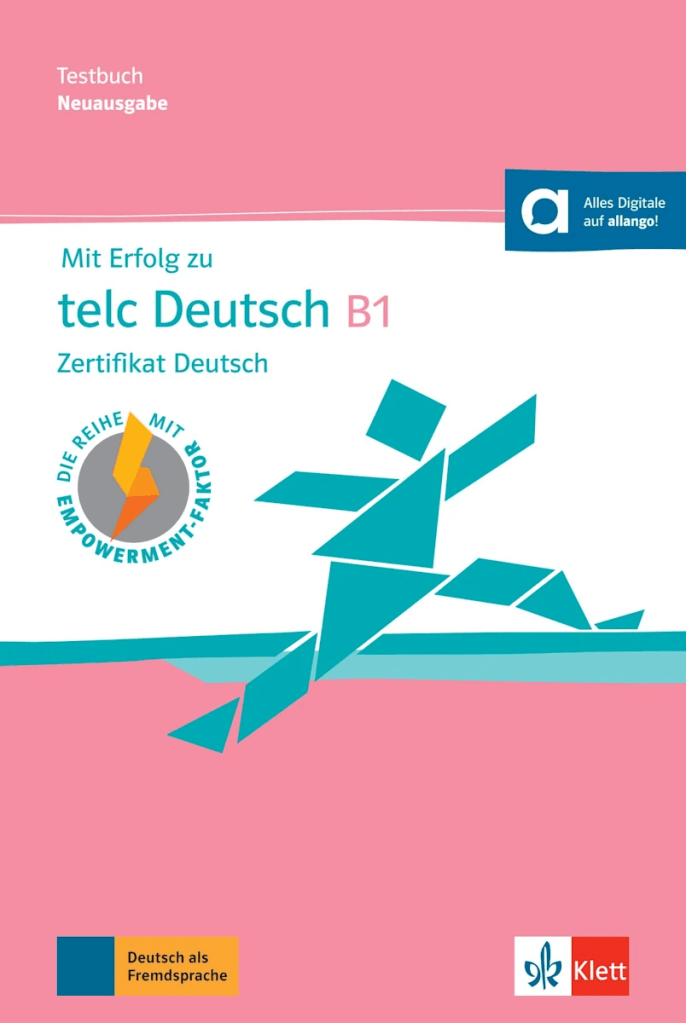
I recommend Mit Erfolg zu telc Deutsch B1 to prepare. It’s got four model tests in it, which doesn’t sound like much, but it’s actually plenty.
If you’re currently working at A2 level and are hoping to take the B1 exam, I’d allow at least 3-4 months to give you sufficient time and practice.
Get more information on the exam here.
Found this post helpful? Please like and share it!



Leave a comment